Showing posts with label historical fiction. Show all posts

Sunday, March 5, 2017

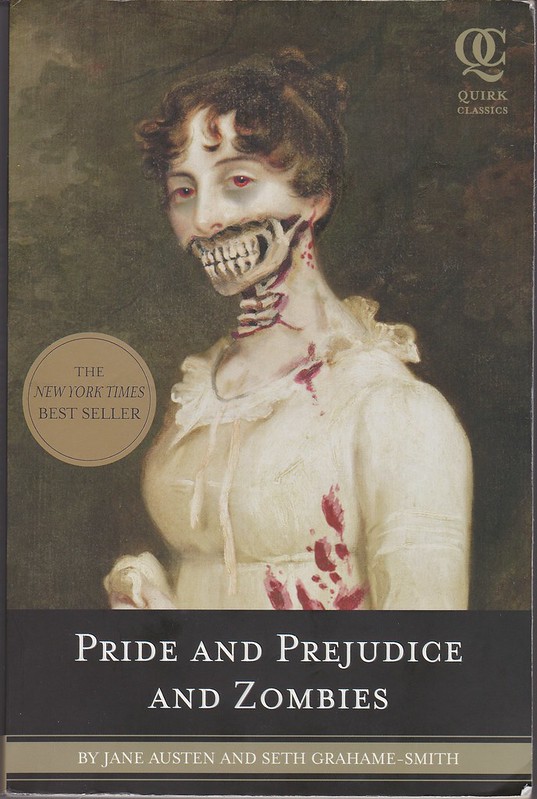
Pride and Prejudice and Zombies

I am back from the longest hiatus ever, and the first book I'd like to share about is Pride and Prejudice and Zombies, by Seth Grahame-Smith (and, of course, our friend Jane Austen).  I'm pleased for this to be the first book I review coming back, as it's one I truly enjoyed.  

A mysterious plague has befallen the nation, so rather than the Napoleonic Wars, the country is battling against the rising dead; the sisters Bennet are trained (and well proficient) in the deadly arts, and although they studied in China rather than the more fashionable Japan, their prowess is nigh incomparable, and they are tasked with the defense of their home at Longbourn and the surrounding neighborhood - until such time as they each marry, as upon taking a nuptial vow, their duty will shift from crown to husband.

I don't think this book needs much more introduction or explanation of the premise than that, since it has been made into a movie, so let's just get right to it, shall we?  As with Sense and Sensibility and Sea Monsters, when I originally bought this book, I wasn't sure whether I'd be going into it with mixed feelings or what, but after having read that, I went into this with much more enthusiasm from the start.  Even though the two novels have different authors, they have a very similar feel, and both Grahame-Smith and Winters have done an equally commendable job of weaving the new elements in with the original stories in a way that makes these books hold their own:  you don't need to have read the original works to understand or appreciate these as stand-alone novels (although I highly recommend that you do read Austen's, because she was a treasure and her collective work is a gift).  

Thursday, May 21, 2015

Her Dear & Loving Husband

Her Dear & Loving Husband, by Meredith Allard, is the first in her Loving Husband trilogy.  After a recent divorce, Sarah Alexander has moved to Salem, Massachusetts.  If she thought the quaint seaside town with all its historic charm would quiet her recurring dreams and night terrors, however, she was very much mistaken - moving to Salem seems to have had the opposite effect, in fact.  

Through a colleague at the library, Sarah meets James Wentworth, a professor at the college, and her resemblance to his late wife causes him to feel drawn to her.  James is hiding a secret which keeps him disconnected from engaging in any kind of a real social life and has kept him from being settled in any one place for very long.  His attachment to Sarah is powerful enough to potentially disrupt the quiet life he's built for himself, but there are questions which need to be answered:  is James attracted to Sarah, or is it her resemblance to his beloved wife which attracts him to her?  And if it IS Sarah he is attracted to, will his secret threaten any romance between them?

With a meddling reporter buzzing around asking questions about James, his secret might come out whether he's ready for Sarah to know it or not - but if exposed to the whole world, James fears a new mass hysteria and hunt will ensue.

Wednesday, February 11, 2015

The Devil's Arithmetic

The Devil's Arithmetic, by Jane Yolen, is an historical fiction novel about the Holocaust, geared toward younger readers.  Thirteen-year-old Hannah is on her way to celebrate Passover with her family, but she'd much rather stay with her friend Rosemary, eating Easter candy.  She feels like every year, the Seder is the same - they do the Seder ritual with dinner and the adults talk about the past, and how important it is to remember.  Hannah doesn't want to talk about things that happened so long ago, and she gets bored of her family's stories.  

When her Grandpa Will declares that she will be the one to open the front door for the prophet Elijah this year, Hannah feels silly, but she goes along with the tradition.  Upon opening the door, however, she doesn't see the apartment building's hallway and the doors to the neighbors' apartments - instead, she finds herself transported to another time and place.  She has, in fact, been transported to Poland of the 1940s, where she will come to experience for herself the horror of the stories she used to dismiss.

Monday, August 19, 2013

Standing in the Light

Standing in the Light:  The Captive Diary of Catharine Carey Logan is a fictional diary by Mary Pope Osborne, written for the Dear America series.  Caty Logan is a 13-year-old girl living with her family in the Delaware Valley in Pennsylvania.  The Logans are Quakers - a pacifist religious group that began in England and spread to North America in the late 1600s, when some of them emigrated to escape religious persecution.  Quakers have been historically very politically active in the fight for universal civil rights and gender equality, although they also tend to practice modesty and humility in general behavior and appearance (at least during the time in which this book is set).

It is 1763, just after the French and Indian War, and Caty is worried because there have been reports of raids on farmers around the valley, in retaliation of the English government going back on their treaties with the local villages regarding land ownership.  Caty's father believes that their family will be safe if they show the Indians that they trust them, and has faith in the friendly relations the Quakers have had with the Delaware Indians in the past.  Despite this, however, Caty and her brother Thomas are taken captive on their way to school one winter morning; after hearing the rumors at school of people being scalped, Caty fears the worst.

After a while, Caty loses track of the days, though curiosity and what seems like admiration causes her captors to allow her to continue writing in her diary, and from the day she and Thomas are taken, the book becomes a letter to their father, in case it should ever find its way back to him.

Once the small party reaches a village, Thomas is taken away:  will she ever see him or the rest of their family again?

Thursday, June 14, 2012

Puppet

Puppet by Eva Wiseman is a young adult novel based on actual events and a real trial.  In a small Hungarian village in 1882, 14-year-old Julie's friend Esther goes missing.  She was last seen when on an errand for her cruel mistress, and blame is quick to be placed on the community's Jewish population.  Fear and hatred run wild as accusations are made:  it is believed that some of the Jewish men lured Esther into the synagogue and murdered her, slitting her throat and collecting her blood to be used in a Passover ritual.  This awful lie was firmly believed, and is known as the Blood Libel.  The accusations are taken very seriously, and some of the Jews are arrested.  Among them, two children, the Scharf brothers.  Sam is too young to be taken seriously as a material witness in court, so pressure is placed on his older brother Morris to confess (I'm sure you can guess the physical nature of this pressure) and he is coached to testify against the accused.

Julie is swept up in the arrests and the trial when she is sent by her abusive father to work as housekeeper at the jail, then is given a position as the scullery maid at the prison in the city.  She used to play with Morris as a child, and she isn't so sure the Jews are as evil and murderous as everyone says they are; but if they didn't kill her friend, what did happen to Esther?  As the trial progresses, Julie is pulled in deeper, and must make a choice between doing what she feels is right and doing what is safe.

When I read The Last Song by Wiseman, I was impressed with her ability to fictionalize such awful and tragic historical events in a way that is engrossing without trivializing them.  I was just as captivated with Puppet.  This book won multiple awards, and it's not hard to see why; I read the majority of this book in one night.  I've always had a sort of morbid fascination with the historical persecution of the Jewish people (you can probably blame my fifth grade teacher for assigning Lois Lowry's Number the Stars, which quickly became one of my all-time favorite books).  So for me, knowing that the events and the people in this book are very real (with the exception, I believe, of Julie and her family) really made Puppet that much more interesting, and that much more impossible to put down once I'd gotten into it.

Saturday, June 9, 2012

True Women

True Women by Janice Woods Windle is a semi-biographical novel of the lives of her own ancestors.  Growing up with stories passed down through the generations in her family, Windle went on to do serious genealogical research, leading to this novel.  True Women takes us through the lives of specifically three women in the author's family tree (which is diagrammed at the beginning of the book):  Euphemia Texas Asby King, Georgia Virginia Lawshe Woods, and Bettie Moss King.  Their stories span from the time of the Republic of Texas, through what seems like war after war after war, up until the present day, when the author is learning more about these women from Idella, an old woman with an intuitive gift.

I was born in East Texas, and I currently live in the area schoolchildren learn as the "prairies and lakes" region of Texas.  We moved around a lot during my childhood, though, and I don't self-identify as Texan.  But while I've personally never felt any real connection with the state, I think it's no secret how proud others are to call themselves Texan.  Some (many) of them, obnoxiously so.  I never much understood it.

This book, however, is about generations of people who have every reason to be proud of being Texan.  Euphemia, her sisters, and many hundreds of other women and children fled from Santa Anna's army in what became known as the Runaway Scrape.  They helped to make Texas the Republic it once was, and  managed not only to just survive in the harsh environments they chose to call home, but they worked hard and came to thrive in what I feel is a nearly impossible place to live.  This is the part of the book that really sets it apart from others for me.  Other states have a lot of history from the scars left by the many wars this country has seen, but the time of the Texas Republic is something else.  I've always thought the obnoxious and blind state pride I've seen in Texas was silly, but for those whose roots go as deep as this, I can certainly see what there is to be proud of.  As for myself, I can't say I have any more pride in being born in Texas after having read this book, but I have a much greater respect for the history and the people who struggled through and fought for its beginnings.

Sunday, May 13, 2012

Sophie and the Rising Sun


Sophie and the Rising Sun by Augusta Trobaugh is a short, sweet, and simple romantic novel taking place during World War II.  Part of the story is being told by Miss Anne, a kind and quietly unconventional woman; she doesn't know all the details, however, so the rest is filled in for us.  The story is of Sophie, a woman raised by her strict mother and aunts, and whose only real indiscretion being her love for a young man who never returned from the Great War.  Then there is Mr Oto, a first-generation American who was sent from California to New York with funds to bring back a relative who had come over from Japan.  He loses the money, but too ashamed to face his family, he makes his way south, where he ends up in the small town of Salty Creek, Georgia.  Mr Oto is a soft-spoken and respectful gentleman, and soon becomes friends with Miss Anne, who has hired him as her gardener.  Every day as he works in the flowerbeds, he sees Sophie walk by the house, and it is not long before he is completely infatuated with her.  The two grow very close over time, as they meet every Sunday in the same spot by the river to paint.  

Things change very quickly, though, when the Japanese bomb Pearl Harbor.  Everyone in town except Miss Anne and Sophie have been under the assumption that he is Chinese, but they know it likely won't be long before the growing anger toward the Japanese causes them to react anyway.  He is already not the most well-liked individual, what with being colored in the pre-Civil Rights South, and Miss Anne fears for his safety.  She makes a plan to hide him, and makes up a story that he's gone to Canada to be with his family.  The lies weigh heavily on her, and Mr Oto wonders whether he will see Sophie again.

Sunday, April 22, 2012

The Last Song

The Last Song by Eva Wiseman is a gripping juvenile fiction novel set in Toledo, Spain during the infamous Spanish Inquisition.  The Inquisitor General has come to the city, and while the Jews themselves are not exactly treated with kindness, it's the "Conversos" who are being persecuted here - the people who only recently converted to Christianity.  If any of them are caught or suspected to still be practicing the Jewish faith while pretending to be Christian, they are arrested for heresy and tortured into a confession, whereupon they are burned at the stake.

Fourteen-year-old Isabel has seen the grim procession of prisoners through the city, and though a devout Catholic herself, questions the humanity of it all.  She is quickly hushed, though, because to even doubt the Inquisition is to mark yourself as either a heretic or a traitor.  Isabel is from a fairly well-off and respected family - her father is physician to the royal court - and inside the walls of her home and with the comfort of her personal shrine to the Virgin Mother, the world feels safe and normal.  Her world is turned upside down, though, when she is betrothed to the son of Don Alfonso, a Cavalier.  Luis is cruel and disrespectful, but her parents ignore her pleas not to marry him.  They insist it is to ensure her safety from the Inquisition, as Don Alfonso's family has a long history in the Catholic church; Isabel is confused why she should need any protection from the Inquisition, but her parents then tell her the impossible truth - they are Conversos.  Their grandparents were forced to convert, but their family continued to practice their Jewish faith in secret.

The news breaks everything Isabel thought she knew about herself - she feels she is as devout a Catholic as ever, but is she truly also a Jew?  Can she be both, or must she choose?  Whatever she does, however, she is sworn to secrecy, for all their lives depend on no one discovering the truth of their heritage.  Isabel wants to learn all she can about this new part of her identity, but can she satisfy her mounting curiosity without giving away her family's secret?  The Inquisitor General's men are everywhere, and it is impossible to know who can be trusted.

Friday, April 20, 2012

Yesterday's Dead

Yesterday's Dead by Pat Bourke is a middle grade novel set in Toronto in 1918.  Meredith Hollings is a 13-year-old girl who must leave her small hometown of Port Stuart to become a maid for a doctor's family in Toronto.  Her father left and was killed in the war, and their family's store isn't bringing in quite enough.  She regrets having to leave school, since she dreamed of becoming a teacher someday (and who will hire a teacher who didn't even go to high school?).

Meredith decides, however, that her time in Toronto will be an adventure, and she may just get a little more than she bargained for with that.  The rest of the household staff are mostly pleasant - kind Mrs Butters runs the kitchen and helps her to feel more at home; Forrest, the chauffeur and sort of jack-of-all-trades for the house; Mrs O'Hagan, who doesn't live in the house, but comes to clean and do the laundry.  Mrs O'Hagan's son, Tommy, is also very nice, and he offers to show Meredith around the city on her day off.  Parker, the butler, on the other hand, is not very pleasant at all.  He seems to find fault with everything Meredith does, and is generally a grouch.

The members of Doctor Waterton's family are perhaps a different story altogether, apart from the doctor himself.  The eldest, fifteen-year-old Jack, is a flirt who teases Meredith every time he sees her; Maggie, who is Meredith's age, is a brat with airs of entitlement; the youngest, Harry, is a handful - he's always getting into something, mainly the sugar.

Despite some of the difficulties, Meredith is doing her best and doing a pretty good job, but when the Spanish influenza sweeps through Toronto, it doesn't skip the doctor's house.  Meredith has her work cut out for her trying to get all the regular housework done while also taking care of the members of the household who have fallen victim to the flu.  The doctor is detained for days at the hospital as waves of people are brought in, and he's ordered them all to quarantine themselves inside the house - no one goes in, no one leaves - to try and keep anything from spreading even further.  He doesn't know, however, that nearly everyone in the house is now ill, and Meredith is running the place nearly on her own.  People around the city are dying every day - will she be able to maintain everything in the house until Dr Waterton gets back?  She's been relatively lucky so far, but with all their lives in Meredith's hands, what will happen if she also falls ill?

Tuesday, February 28, 2012

The Darkening Dream

Andy Gavin's debut novel, The Darkening Dream, takes place in Salem, Massachusetts in 1913.  If you think this is a book about puritans and witches, however, think again.  It is so much more, although the location's infamous history does figure into the story in interesting ways.

Sarah Engelmann, the teenage daughter of a rabbi, begins to have unsettling dreams and also hears the sound of a horn being blown, even when awake.  These strange dreams take on new and even more unsettling meaning when Sarah and her friends - twins Anne and Sam Williams, and their new Greek classmate, Alex - discover the body of a young man, whose corpse bears what appear to be what Sarah discerns as evidence of some kind of ritual.  She turns out to be correct, when they see the dead boy again after his funeral.  Alex reveals himself to have quite a knowledge of the undead, and the foursome become determined to find and destroy the vampire who turned him (after dealing with him first, of course).  

The plot thickens and faith is tested as they find that they have gotten themselves involved in something much more complicated than simply the arrival of a centuries-old vampire:  he is in league with gods of the Egyptian pantheon, who want the Archangel Gabriel's trumpet, and a powerful warlock with a demon lover who has the ability to travel between celestial realms.  Deep secrets are unveiled and Sarah becomes attuned to her faith in ways she never knew possible, and with the help of her father, she uses what she's learned to help her friends in the battle they are now desperate to fight.  The stakes have become very high, and Sarah's dreams are becoming more and more disturbing.  Will they be able to stop the forces they have pitted themselves against?  Are they even ready to pay what it might cost them to win?

Monday, November 14, 2011

The Smuggler's Treasure

The Smuggler's Treasure by Sarah Masters Buckey is the first book in the American Girl: History Mysteries series.  When I was a kid, I really adored American Girl, and even now that I'm definitely on the "and up" side of "for ages 10 and up," I still enjoy the books for a fun, light read.  The Smuggler's Treasure is the story of a ship captain's daughter, Elisabet Holder.  It's two years into the War of 1812, and Elisabet's father has been captured by the British.  Her mother has been long dead, and her father's accountant believes her father may be dead now as well, so she makes the long trip by sea from Boston to New Orleans, to stay with an aunt and uncle she's never met - her only living relatives.

Arriving in the strange new city is, for Elisabet, like going to another country - the Louisiana Purchase has only just occurred recently, so the residents are still very much French or Spanish at heart.  On top of this, she finds out that she is expected to work in her aunt and uncle's bakery as a shop assistant; this is very different from living in Boston with her father, where she went to school and had servants to wait on her.  When she learns news of the ship that took her father prisoner, however, and is determined to rescue him from the British, she soon learns the value of friendship despite social class boundaries.

Monday, June 20, 2011

Voyage on the Great Titanic


Voyage on the Great Titanic: The Diary of Margaret Ann Brady by Ellen Emerson White is a part of the Dear America collection for children/young adults. The books are written as though you are reading the main character's diary, and started being published widely after the American Girls series got very popular. I got this one at a book fair in middle school, and I still enjoyed reading it as an adult.

Margaret Ann Brady is an orphaned girl in England who is living in a home and school run by nuns, one of whom has given her a diary, which is where the book essentially begins. Margaret fills the reader in on her back-story - about her parents and her brother, and how she came to be at the orphanage. But she has also been taken on by a wealthy American woman to act as a companion on board the Titanic. While I'm sure we all know the story of that tragic event, I found it interesting to read about from Margaret's perspective, and the historical significance is not made light of although the book is intended for a fairly young audience.

Friday, May 6, 2011

Catherine, Called Birdy


Okay, so I know I thought before that I would have more time for new posts, but that did not turn out to be the truth. School seems to get more hectic every semester! But the good news is that finals for this Spring are next week, and I won't have classes again until July; so I will have more time for leisure reading and to post more frequently (for real this time)!

Anyway, tonight I want to talk about Catherine, Called Birdy by Karen Cushman. This book came out back when I was in maybe the fourth or fifth grade - I thoroughly enjoyed it then, and it was a fun book to revisit. The format of the story is as if you are reading Catherine's diary, which I always like, because I am a nosy person. Obviously, if you are someone who likes having a certain depth in multiple characters, this book is not for you, but I think it is fun to read books set up this way, too.