Showing posts with label murder. Show all posts

Sunday, April 9, 2017

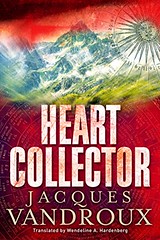
Heart Collector

Heart Collector, originally published as Au Cœur du Solstice, is a crime thriller by French author Jacques Vandroux (translated by Wendeline Hardenberg).  I wish the translation hadn't completely altered the title, because the original title makes much more sense.  That is neither here nor there, though, and any other slight awkwardness in the writing that could be a product of translation didn't detract from the story, to me.

In Heart Collector, we follow police captain Nadia Barka as she investigates a series of abductions (and subsequent murders) of young women in Grenoble, a city nestled at the foot of the French Alps.  Assisting in the investigation is Julien, a computer technician who, for some reason, is having visions of the victims just hours prior to their deaths.  Despite knowing how crazy it will make him seem, Julien brings his information to the police, where he is obviously met with skepticism.

Capt. Barka feels she has nothing to lose from following Julien's tips, however, as there are few enough viable leads for this case, and some of the details of the murders bring to mind a case from her past that still haunts her - the murder of another young woman who had been seemingly tortured extensively before being killed.  Not to mention the fact that these particular murders are especially gruesome - the victims' hearts are nowhere to be found, having been expertly removed.  It becomes a race against time when Julien has a vision of yet another woman:  will he and the police reach her before her heart is removed as well?

----------------------

I got this book through Amazon's Kindle First program, and I'm really glad I selected it as my free ebook for that month.  When I read the premise, I wasn't sure what to expect, since this seems to be marketed more as mystery/suspense/crime fiction rather than as, like...urban fantasy or something, so it was anyone's guess whether the 6th sense element would end up being too corny, or if it would even work within the context of this story at all.

Tuesday, October 1, 2013

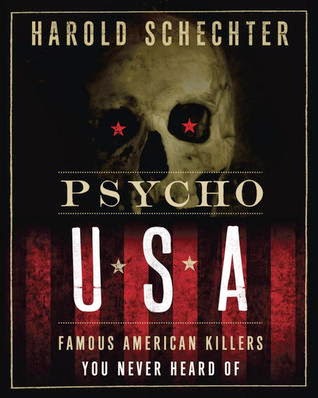
Pyscho USA: Famous American Killers You Never Heard Of

Psycho USA by Harold Schechter is a non-fiction true crime ebook that I received through NetGalley.  In this book, Schechter has compiled short but gruesome accounts of several of the most shocking murderers in United States history.  These men and women were, in their respective times, considered to be the perpetrators of Crimes of the Century - the most vile and atrocious fiends this country had ever seen.  But they have since faded into obscurity.

Now, however, Schechter has brought them back.  Psycho USA is separated into seven sections, each representing different eras, and each chapter within those sections is devoted to one killer.  Section I, for example, covers the period from 1782-1826, and the last section covers from 1941-1961.  Within many of the chapters are also some side-note boxes, covering points of interest that are mentioned in the main text, such as murder ballads or a discussion on the history and/or psychology behind a particular style of murder.  I found these very interesting, and although I call them "side notes," they're really more like mini-chapters in some cases, since they're more than just little blurbs.  They're just not always specifically about the person who was discussed in that chapter.

Schechter also includes a fair few photos and a lot of quotes from the killers' confessions.  Some of these people just look so "normal," that it really makes me think more about how you really can never tell with anyone how flipping crazy they might be just from looking at them.  Reading the words of some of them, however, it kind of slaps you in the face with how obviously unbalanced they were, and you have to wonder how in the world the people who knew them didn't realize this before the person finally got found out and convicted.

Tuesday, August 6, 2013

A Time to Kill

John Grisham's first novel, A Time to Kill, is a courtroom drama set in 1980s Clanton, Mississippi.  A 10-year-old girl is raped and left for dead by two men, who are subsequently arrested for the crime.  The father, Vietnam veteran Carl Lee Hailey, acquires an M-16 and kills them both as they exit the courthouse after their hearing.  This seems pretty cut and dry:  except it becomes a huge controversy in the small town, because Carl Lee and his daughter are black, and the two men are white.  These days, most people I think would either think "so?" or else would not admit to having a prejudice, but this is a small Southern town with a mostly white population, and being that it is the 1980s, the Civil Rights Movement really wasn't all that long ago.  So there is a strong racial overtone to the issue, and this sets the stage for the rest of the book, especially when Carl Lee's trial makes national news, and the KKK gets involved.

----------------

I'll be honest with you guys.  Courtroom drama and legal thrillers are not really my thing.  Sure, I am studying criminal justice as a minor, but my concentration is in forensics:  I'm more interested in the investigation and laboratory analysis side of things, not so much the hanging-around-in-a-courthouse-and-meeting-with-lawyers side of things.  So if this book had not been assigned for the criminal justice class I've been taking this summer, I would probably not have ever bothered to pick this up.  It was my first time reading Grisham, and may well be the last.  I know he is a best-selling author, but this just was not for me.  I haven't seen the movie adaptation, so maybe adding a live-action element makes the story more compelling, but as far as the book goes, I was actually pretty bored through about 99% of it.

Monday, September 24, 2012

Beneath A Rising Moon

Beneath A Rising Moon, by Keri Arthur, is the first book in her Ripple Creek Werewolves series.  In the version of the world Arthur has created, humans and werewolves coexist, albeit maybe not too harmoniously.  Werewolves live in their own towns (reservations), there are certain measures upheld to control the werewolf population (basically, the males get some kind of birth control injection), and laws which apply to humans also apply to werewolves.  The werewolves do, however, have their own branch of law enforcement to deal with their own kind:  the rangers.  And it's a damned good thing, too.

So basic werewolf lore tells us that the full moon is a pretty big deal, and Arthur sticks to this.  The nights leading up to the full moon, everyone is more and more attuned to their wolfiness.  In Ripple Creek, Colorado, the Sinclair mansion outside town becomes the red light district; masked and clad in either nothing or next-to-nothing, they participate all night, every night of the moon phase in what is known as "the moon dance."  It seems to be akin to the idea of some kind of sexy pagan festival honoring the moon goddess.  There are centuries-old rules and rituals associated with it, and basically in this entire book, any time you see the word "dance," they are talking about sex.  Dancing = Sexing It Up.  Reverend Moore would have a heart attack.

Anyway, Neva Grant is part of the golden pack in town; telepathic and a powerful empath, she can use the energy from her own feelings and the feelings of others as a sort of psychic weapon.  Her twin sister, Savannah, is a ranger who has been investigating what appears to be a serial murder case; Savannah's determination and tenacity on the job has landed her a room in the ICU, unconscious, and Neva has made a vow to the moon to catch her sister's attacker.  Her plan for continuing the investigation is crazy and potentially dangerous, both to her physical person and her reputation in the pack.

The main lead in the case is the fact that the murderer is a silver wolf, which means the Sinclair family, the head of their silver pack, is at the top of the suspect list.  In fact, they basically make up the entire suspect list.  Their reputation in town among the more conservative golden pack doesn't help, either.  Word is that Duncan Sinclair, the most lascivious of them all, has returned after a ten year absence, and the easiest way Neva figures to gain access to the mansion is to seduce Duncan at the dance.  Once in, everyone else will be too occupied with copulating to pay attention to her snooping.  

What she didn't figure on, however, was the way she would react to him.  To his touch, his scent, his voice...to every part of him.  He seems to be living up to his reputation, though, so to allow herself to feel something for him, to hope that there could be more to their relationship than just the moon dance, would be crazy.  But it's too late to back out now...her sister is hanging on by a thread, and more women could be killed if this case isn't resolved.

--------------

I received this as an eBook from NetGalley, and it's actually the first eBook I've ever read.  I think I picked a good one!  Ha.  I'm a big fan of romance novels, whether they're good or so-bad-they're-good, and I really enjoyed this one; I read it straight through in one night.  The only other werewolf books I've read were Alisa Sheckley's Abra Barrow duology, and while I thought there was a lot of sexytimes either happening or being referred to in those books, this one has those beat.  If you are one of those people who skims along and skims along in a romance novel, just to get to the juicy bits, you might like Beneath A Rising Moon.  The smut begins early in the first chapter and is pretty constant throughout the entire book.

Thursday, June 14, 2012

Puppet

Puppet by Eva Wiseman is a young adult novel based on actual events and a real trial.  In a small Hungarian village in 1882, 14-year-old Julie's friend Esther goes missing.  She was last seen when on an errand for her cruel mistress, and blame is quick to be placed on the community's Jewish population.  Fear and hatred run wild as accusations are made:  it is believed that some of the Jewish men lured Esther into the synagogue and murdered her, slitting her throat and collecting her blood to be used in a Passover ritual.  This awful lie was firmly believed, and is known as the Blood Libel.  The accusations are taken very seriously, and some of the Jews are arrested.  Among them, two children, the Scharf brothers.  Sam is too young to be taken seriously as a material witness in court, so pressure is placed on his older brother Morris to confess (I'm sure you can guess the physical nature of this pressure) and he is coached to testify against the accused.

Julie is swept up in the arrests and the trial when she is sent by her abusive father to work as housekeeper at the jail, then is given a position as the scullery maid at the prison in the city.  She used to play with Morris as a child, and she isn't so sure the Jews are as evil and murderous as everyone says they are; but if they didn't kill her friend, what did happen to Esther?  As the trial progresses, Julie is pulled in deeper, and must make a choice between doing what she feels is right and doing what is safe.

When I read The Last Song by Wiseman, I was impressed with her ability to fictionalize such awful and tragic historical events in a way that is engrossing without trivializing them.  I was just as captivated with Puppet.  This book won multiple awards, and it's not hard to see why; I read the majority of this book in one night.  I've always had a sort of morbid fascination with the historical persecution of the Jewish people (you can probably blame my fifth grade teacher for assigning Lois Lowry's Number the Stars, which quickly became one of my all-time favorite books).  So for me, knowing that the events and the people in this book are very real (with the exception, I believe, of Julie and her family) really made Puppet that much more interesting, and that much more impossible to put down once I'd gotten into it.

Friday, January 20, 2012

The Lovely Bones

The Lovely Bones by Alice Sebold is a story centering around a fourteen-year-old girl, Susie Salmon, who is raped and murdered near her home in the 1970s.  She narrates the story after death, as she watches over her family and keeps tabs on her killer from her heaven.  She follows each of her family members as they deal with her death, each in very different ways.  She follows Ruth, a classmate who felt her presence as she passed through a parking lot from this world to the next and whose life is never the same from that moment on.  She follows Ray Singh, another classmate who was in love with her - her almost and only romance.  And she follows the man who took her life.

Rape is difficult for me to read, and it's even more awful to me in this book because of Susie's young age and the gruesome way in which she dies afterward.  Sebold treats this delicate subject matter well, though; perhaps because she herself was a victim of rape.  The scene isn't drawn out, and we get only those details which are vital to the understanding of the story.  So to anyone wary of picking this up because of this topic, I would at least give it a go, because the reading of it isn't as bad as I anticipated.  Of course, you may end up not being able to get through it, but trust me - at least try, because it's really an extraordinary book.