Showing posts with label adult fiction. Show all posts

Sunday, April 9, 2017

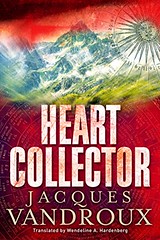
Heart Collector

Heart Collector, originally published as Au Cœur du Solstice, is a crime thriller by French author Jacques Vandroux (translated by Wendeline Hardenberg).  I wish the translation hadn't completely altered the title, because the original title makes much more sense.  That is neither here nor there, though, and any other slight awkwardness in the writing that could be a product of translation didn't detract from the story, to me.

In Heart Collector, we follow police captain Nadia Barka as she investigates a series of abductions (and subsequent murders) of young women in Grenoble, a city nestled at the foot of the French Alps.  Assisting in the investigation is Julien, a computer technician who, for some reason, is having visions of the victims just hours prior to their deaths.  Despite knowing how crazy it will make him seem, Julien brings his information to the police, where he is obviously met with skepticism.

Capt. Barka feels she has nothing to lose from following Julien's tips, however, as there are few enough viable leads for this case, and some of the details of the murders bring to mind a case from her past that still haunts her - the murder of another young woman who had been seemingly tortured extensively before being killed.  Not to mention the fact that these particular murders are especially gruesome - the victims' hearts are nowhere to be found, having been expertly removed.  It becomes a race against time when Julien has a vision of yet another woman:  will he and the police reach her before her heart is removed as well?

----------------------

I got this book through Amazon's Kindle First program, and I'm really glad I selected it as my free ebook for that month.  When I read the premise, I wasn't sure what to expect, since this seems to be marketed more as mystery/suspense/crime fiction rather than as, like...urban fantasy or something, so it was anyone's guess whether the 6th sense element would end up being too corny, or if it would even work within the context of this story at all.

Sunday, March 5, 2017

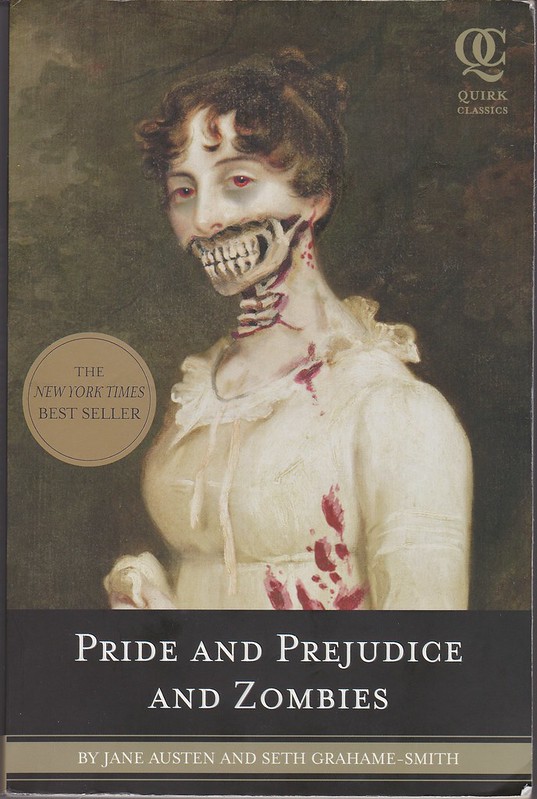
Pride and Prejudice and Zombies

I am back from the longest hiatus ever, and the first book I'd like to share about is Pride and Prejudice and Zombies, by Seth Grahame-Smith (and, of course, our friend Jane Austen).  I'm pleased for this to be the first book I review coming back, as it's one I truly enjoyed.  

A mysterious plague has befallen the nation, so rather than the Napoleonic Wars, the country is battling against the rising dead; the sisters Bennet are trained (and well proficient) in the deadly arts, and although they studied in China rather than the more fashionable Japan, their prowess is nigh incomparable, and they are tasked with the defense of their home at Longbourn and the surrounding neighborhood - until such time as they each marry, as upon taking a nuptial vow, their duty will shift from crown to husband.

I don't think this book needs much more introduction or explanation of the premise than that, since it has been made into a movie, so let's just get right to it, shall we?  As with Sense and Sensibility and Sea Monsters, when I originally bought this book, I wasn't sure whether I'd be going into it with mixed feelings or what, but after having read that, I went into this with much more enthusiasm from the start.  Even though the two novels have different authors, they have a very similar feel, and both Grahame-Smith and Winters have done an equally commendable job of weaving the new elements in with the original stories in a way that makes these books hold their own:  you don't need to have read the original works to understand or appreciate these as stand-alone novels (although I highly recommend that you do read Austen's, because she was a treasure and her collective work is a gift).  

Thursday, May 21, 2015

Her Dear & Loving Husband

Her Dear & Loving Husband, by Meredith Allard, is the first in her Loving Husband trilogy.  After a recent divorce, Sarah Alexander has moved to Salem, Massachusetts.  If she thought the quaint seaside town with all its historic charm would quiet her recurring dreams and night terrors, however, she was very much mistaken - moving to Salem seems to have had the opposite effect, in fact.  

Through a colleague at the library, Sarah meets James Wentworth, a professor at the college, and her resemblance to his late wife causes him to feel drawn to her.  James is hiding a secret which keeps him disconnected from engaging in any kind of a real social life and has kept him from being settled in any one place for very long.  His attachment to Sarah is powerful enough to potentially disrupt the quiet life he's built for himself, but there are questions which need to be answered:  is James attracted to Sarah, or is it her resemblance to his beloved wife which attracts him to her?  And if it IS Sarah he is attracted to, will his secret threaten any romance between them?

With a meddling reporter buzzing around asking questions about James, his secret might come out whether he's ready for Sarah to know it or not - but if exposed to the whole world, James fears a new mass hysteria and hunt will ensue.

Tuesday, August 6, 2013

A Time to Kill

John Grisham's first novel, A Time to Kill, is a courtroom drama set in 1980s Clanton, Mississippi.  A 10-year-old girl is raped and left for dead by two men, who are subsequently arrested for the crime.  The father, Vietnam veteran Carl Lee Hailey, acquires an M-16 and kills them both as they exit the courthouse after their hearing.  This seems pretty cut and dry:  except it becomes a huge controversy in the small town, because Carl Lee and his daughter are black, and the two men are white.  These days, most people I think would either think "so?" or else would not admit to having a prejudice, but this is a small Southern town with a mostly white population, and being that it is the 1980s, the Civil Rights Movement really wasn't all that long ago.  So there is a strong racial overtone to the issue, and this sets the stage for the rest of the book, especially when Carl Lee's trial makes national news, and the KKK gets involved.

----------------

I'll be honest with you guys.  Courtroom drama and legal thrillers are not really my thing.  Sure, I am studying criminal justice as a minor, but my concentration is in forensics:  I'm more interested in the investigation and laboratory analysis side of things, not so much the hanging-around-in-a-courthouse-and-meeting-with-lawyers side of things.  So if this book had not been assigned for the criminal justice class I've been taking this summer, I would probably not have ever bothered to pick this up.  It was my first time reading Grisham, and may well be the last.  I know he is a best-selling author, but this just was not for me.  I haven't seen the movie adaptation, so maybe adding a live-action element makes the story more compelling, but as far as the book goes, I was actually pretty bored through about 99% of it.

Monday, September 3, 2012

Fifty Shades of Grey

Twilight: Reimagined Fifty Shades of Grey by E.L. James is a book about an impossibly naïve, sexually oblivious soon-to-be college graduate, Anastasia Steele, and her toxic relationship with the unbelievably handsome and obscenely wealthy businessman, Christian Grey.  Ana's roommate, Kate, is supposed to interview Christian for the university newspaper, but is too sick to leave the apartment, so Ana fills in for her, even though she doesn't even work for the paper at all, and probably there were other students who are actually involved with the paper who were available and could have used the experience for their CVs or graduate school applications.  Anyway, so Ana meets Christian Grey and for the first time in her entire twenty-one years of life, she feels attracted to a man!  He is so incredibly good-looking that, already nervous anyway, she fumbles her way through the interview as best she can, then wants to die a little bit afterward, because she feels so foolish about some of the things she said.

On the way home, she is so flustered that she keeps talking about how pissed she is and how inconsiderate it was for Kate to have her do this interview without giving her some kind of briefing about this guy first.  ANA.  This is the age of the internet.  Even though she does not have her own computer, it would have been more than easy to look him up online.  And how she even made it through college - as a lit major, especially...you know she had papers and essays probably constantly - without her own computer is beyond me.  She must have spent a LOT of time at the library or in the school's writing lab.

It's fine, though, because she will never have to see that sinfully beautiful man again, right?  NOPE.  He shows up at her place of work, to purchase some harmless home hardware, to be used for some  mysterious and let's be honest, unimaginative purpose.  While helping Grey find these for-now-innocent items, some guy she knows shows up who asks her out every time he sees her.  As if in the good spirit of foreshadowing, Grey immediately becomes tense and suspicious.  If this were a wildlife documentary instead of whatever it is, Grey would be exhibiting some kind of visual and/or auditory behavior in an attempt to signal his claim on Ana as a potential mate.  This isn't a wildlife documentary, though, but nonetheless, he seems to be barely able to contain himself from an open display of competition for sexual resources.

Ana blows the lesser male off and is in total bliss over securing Grey's phone number and flatters herself with the notion that he came there just to see her.  Oh my, he must really like her or something, jeez!

So she calls him under the pretense of needing some photos to go with Kate's write-up of the interview, and they force their nature photographer friend, José, to broaden his occupational horizons and do his best to capture Grey's inhuman beauty on film or memory card.  The same kind of silent competitive exchange occurs between Grey and José, because José it turns out is also in love with Ana!  But heaven knows why, since she is so plain and clumsy, and it didn't matter because up until that fateful day of the interview, she was asexual anyway.  Not anymore, though!  Miracle of miracles, Grey the Grecian God has asked Ana to accompany him for a coffee.  And /SQUEE, he actually holds her hand! No one has ever done that before!  When they are leaving, clumsy little thing that she is, she almost gets run over by a cyclist in the street, but Grey, in his instinctive protective prowess, saves her!  She mentally begs him to kiss her, but as if he can read her mind, he says no.  And tells her that he is no good for her, and she would do best to stay away.

HOW CAN THIS BE? He HELD her HAND for goodness' sake!  So she pretends to have dignity and waits until rounding the corner out of sight before crumpling to the pavement to cry like an idiot.

(And it only gets more romantic from here, guys.  Get comfortable, because there is an awful lot to say about this book; I'm including a cut here, so the entire homepage doesn't get taken over with this)
Wednesday, July 4, 2012

It's Time: Writing on the Wall

Pavel Kostin's It's Time is a somewhat philosophical novel set in contemporary urban Russia.  Max is a young man working as a night watchman who doesn't do much besides work and hang out around the city with his friends, a small group of street artists.  At the book's opening, Max is sitting on the edge of the roof on a tall building - there seems to be a sort of panic below him on the street, but Max is rather calm.  He isn't up on the roof alone, either; a strange and beautiful young woman who calls herself "Lady F" appears near him and they chat.  After this, she shows up throughout the story at the most random moments.  Mysterious and a little cryptic.  Max and his friends contemplate life, the future, and art, and Max tags along as his friends tag the walls of the city.  Every blank wall is a potential canvas, and the city is their gallery.  

This might sound so far like some kind of pretentious hipster philosophy, a beatnik novel for this generation.  When I read the synopsis on LibraryThing (I received the book through their Early Reviewers program), I kind of expected some sort of modern day Russian La Bohème.  That isn't quite what I got, though.  Honestly, the very beginning was a bit slow.  Boring, almost.  It took me a little while before I really got into it.  

And then things get more and more weird, and the rest of the book had me questioning at every turn whether what was happening was real or whether Max was hallucinating.  Lady F keeps showing up and the questions just pile on until at a certain point, I couldn't put the book down until I'd finished it and found out what in the heck was going on.  Things ended up getting very strange, yes, but also rather interesting.  Much like with Julie Cross's Tempest, I'm unsure just how much I can even say without ruining some twist in Max's story.  The philosophical discussions and comments in the book are worth considering as well; some of them are quite poignant, sometimes so much so that they made me stop and really think for a moment, not about the story exactly, but about what was just said and how it does or does not seem to really apply to my own life and my own experience.

Friday, June 22, 2012

Sparks

Sparks is the stunning sequel to Laura Bickle's Embers, an urban fantasy duology (which I hope will turn into a full-on series).  By day, Anya Kalinczyk is an arson investigator for the Detroit Fire Department; by night, she investigates the paranormal with the Detroit Area Ghost Researchers.  Anya is somewhat reluctant to associate herself with the DAGR, partly because she's unsure whether she would still have a job if word got out, but also because she struggles with her role in the group:  disposal.  If DAGR were the Ghostbusters, Anya would be their Proton Pack.

Anya is a Lantern - a kind of medium who has a special connection with the element of fire and control of sorts over its destructive powers.  As a medium, she can see and interact with ghosts, but as a Lantern, she also has the ability to destroy them by essentially sucking them into herself like some kind of heartburn-inducing ectoplasm smoothie.  It isn't something she enjoys doing.  You can imagine this Lantern business can get pretty dangerous, but that ain't nothin' but a thang when you've also got the companionship and protection of an elemental familiar; Sparky, Anya's salamander, has been with her ever since she can remember.  He might be mischievous like a puppy who enjoys making "short" (heh) work of various electrical devices, but he's also a fierce and loyal guardian.

In Sparks, the DFD is confronted with a series of puzzling cases of what appears to be spontaneous combustion.  What's especially troubling about these cases is that Anya can sense old magick at each of the scenes; she suspects they are linked to Hope Solomon, who heads a shady organization in the city called "Miracles for the Masses."  Trying to get enough evidence that isn't paranormal in nature could be a problem, however, and the body count is rising.

Saturday, June 9, 2012

True Women

True Women by Janice Woods Windle is a semi-biographical novel of the lives of her own ancestors.  Growing up with stories passed down through the generations in her family, Windle went on to do serious genealogical research, leading to this novel.  True Women takes us through the lives of specifically three women in the author's family tree (which is diagrammed at the beginning of the book):  Euphemia Texas Asby King, Georgia Virginia Lawshe Woods, and Bettie Moss King.  Their stories span from the time of the Republic of Texas, through what seems like war after war after war, up until the present day, when the author is learning more about these women from Idella, an old woman with an intuitive gift.

I was born in East Texas, and I currently live in the area schoolchildren learn as the "prairies and lakes" region of Texas.  We moved around a lot during my childhood, though, and I don't self-identify as Texan.  But while I've personally never felt any real connection with the state, I think it's no secret how proud others are to call themselves Texan.  Some (many) of them, obnoxiously so.  I never much understood it.

This book, however, is about generations of people who have every reason to be proud of being Texan.  Euphemia, her sisters, and many hundreds of other women and children fled from Santa Anna's army in what became known as the Runaway Scrape.  They helped to make Texas the Republic it once was, and  managed not only to just survive in the harsh environments they chose to call home, but they worked hard and came to thrive in what I feel is a nearly impossible place to live.  This is the part of the book that really sets it apart from others for me.  Other states have a lot of history from the scars left by the many wars this country has seen, but the time of the Texas Republic is something else.  I've always thought the obnoxious and blind state pride I've seen in Texas was silly, but for those whose roots go as deep as this, I can certainly see what there is to be proud of.  As for myself, I can't say I have any more pride in being born in Texas after having read this book, but I have a much greater respect for the history and the people who struggled through and fought for its beginnings.

Tuesday, May 22, 2012

Spin


Spin by Catherine McKenzie is a novel about 30-year-old Kate Sandford, a struggling music journalist in the  big city.  She freelances for small publications, writing about local bands.  Half her friends are still in college and think she's a 25-year-old graduate student, and they spend an awful lot of time partying.  Her best friend from home is on the opposite end of the spectrum - responsible and successful working hard in her career at a bank.    Things seem like they might actually be on the up for Kate, though, when she lands an interview for a position at her dream job:  writing for an edgy music magazine, The Line.  She completely tanks it, though, when she goes out to celebrate the interview and her birthday the night before, and shows up late and still drunk.  

So it's a huge surprise when Kate gets a call asking her to come back for another opportunity - and if she does well with this, she just may be able to get the job she applied for after all.  The assignment?  Going undercover at a rehab facility to get the dirt on Amber Sheppard, the celebrity It Girl of the moment, whose latest exploits have her the focus of every gossip source.  It's not The Line, but the tabloid is published from the same office, and the promise of another shot at her Dream Job is too good to pass up.  All she has to do is make it through the program with Amber, then deliver a juicy article afterward.

Things get complicated, though, when Amber becomes a person to Kate...a friend, actually...rather than just some messed up celebrity brat, and frustrating when friends and family don't seem surprised that she would be in rehab.  Then there is the further complication of Henry.  She needs to decide, and soon, whether her dream job at The Line is worth putting her new friendship (and possible blooming romance) on the line.

Sunday, May 13, 2012

Sophie and the Rising Sun


Sophie and the Rising Sun by Augusta Trobaugh is a short, sweet, and simple romantic novel taking place during World War II.  Part of the story is being told by Miss Anne, a kind and quietly unconventional woman; she doesn't know all the details, however, so the rest is filled in for us.  The story is of Sophie, a woman raised by her strict mother and aunts, and whose only real indiscretion being her love for a young man who never returned from the Great War.  Then there is Mr Oto, a first-generation American who was sent from California to New York with funds to bring back a relative who had come over from Japan.  He loses the money, but too ashamed to face his family, he makes his way south, where he ends up in the small town of Salty Creek, Georgia.  Mr Oto is a soft-spoken and respectful gentleman, and soon becomes friends with Miss Anne, who has hired him as her gardener.  Every day as he works in the flowerbeds, he sees Sophie walk by the house, and it is not long before he is completely infatuated with her.  The two grow very close over time, as they meet every Sunday in the same spot by the river to paint.  

Things change very quickly, though, when the Japanese bomb Pearl Harbor.  Everyone in town except Miss Anne and Sophie have been under the assumption that he is Chinese, but they know it likely won't be long before the growing anger toward the Japanese causes them to react anyway.  He is already not the most well-liked individual, what with being colored in the pre-Civil Rights South, and Miss Anne fears for his safety.  She makes a plan to hide him, and makes up a story that he's gone to Canada to be with his family.  The lies weigh heavily on her, and Mr Oto wonders whether he will see Sophie again.

Wednesday, April 25, 2012

Moonburn

Moonburn by Alisa Sheckley is the sequel to The Better To Hold You; Abra's gotten pretty used to her new lycanthropic lifestyle by now, and is sort-of-happily living with Red, the shapeshifting ginger redneck.  Still living in the house nearby are her soon-to-be-ex-husband, Hunter, and Magda - the Romanian researcher of Unwolves he left her for, who, incidentally, is also the one responsible for Hunter (and so, in turn, Abra) with the lycanthropy virus.  Abra doesn't really seem to mind being a werewolf so much, though, and enjoys working at a small veterinary practice with her former instructor, Malachy.

There are obvious downsides to being a werewolf, though; normally, Abra is just sensitive to the phases of the moon, which she keeps careful track of.  Lately, though, she has been finding it more difficult to control the change, which seems to be trying to happen well before the moon is even full.  That isn't the extent of the strangeness, though - everyone seems to know things about her condition that she isn't aware of, and Red appears to be deliberately keeping information from her.  This is not at all helpful, because she is currently finding it extremely difficult to retain some sense of control over her purely animal instincts, and has become an object of lust for every man and dog that crosses her path, which doesn't exactly help with the strain in her relationship with Red.

What's more, this turns out to be a very inopportune time for these kinds of problems in her personal life.  The small, backwoods town she lives in, Northside, is a sort of paranormal hub where the veil between the physical and the liminal worlds is particularly thin.  A new housing development is being constructed at the mountain, right in the ancient roaming grounds of the manitou - powerful spirits that were recognized by the American Indians who were native to the area, but were forgotten for the most part, over time.  Well, now they are awake and kind of pissed.  Kind of REALLY pissed.  One in particular, taking the forms of a bear/Québécois lumberjack, has come to town to fuck up everybody's day.

First off, I rather enjoyed The Better To Hold You, and likewise, I also enjoyed Moonburn.  I think I enjoyed the former just a little bit better overall, though, if I had to pick one over the other.  Don't get me wrong, this one is certainly not lacking for action of any kind, but it was sometimes almost a little too much.  But I also have a tendency to gag myself and roll my eyes at any tale of The Beautiful Girl Who Doesn't Realize That She's Beautiful Even When Every Boy Wants Her And Is Embarrassingly Obvious About It.  I do like Abra, though. She's not typical as far as heroines of urban fantasy novels go - she doesn't really kick that much ass, and more often than not, she has a tendency to want to shy away.  That makes her feel more like a real person to me, since let's face it - not everyone is some leather-clad, ass-kicking dynamo who seems to live for the moments when danger dares to present itself to her.  Some of us will do what we have to, but would really rather be home in our pajamas doing a whole lot of nothing.  The latter is more Abra's style.  She is a pretty simple lady (you know, apart from the whole werewolf thing) and I can relate to that.