Showing posts with label history. Show all posts

Thursday, January 16, 2014

Witch Hunters: Professional Prickers, Unwitchers & Witch Finders of the Renaissance

Witch Hunters, by P.G. Maxwell-Stuart, is a non-fiction account of a handful of people who were involved in the investigation of witchcraft during the Renaissance - specifically, people who identified witches as a profession by various means.  There are six chapters in this book, each one dedicated to one particular "witch hunter" or style of determining whether someone is a witch or has been touched by witchcraft:  Martín Del Rio, a Jesuit who researched and wrote extensively on the subject of magic and witchcraft; Pierre de Lancre, a lawyer who became famous for his involvement in the investigation of an "outbreak" of witchcraft in southwest France which resulted in the deaths of hundreds of suspected witches; Battista Codronchi, an Italian medical doctor who held that demonic spirits/witchcraft was at the root of many illnesses; Patrick Morton, an alleged victim of demonic possession after an encounter with suspected witches; John Kincaid, a witch-pricker; and Elizabeth Jameson, who titles the final chapter, which deals with the apparently common practice of accusing one's neighbors.

Tuesday, October 1, 2013

Pyscho USA: Famous American Killers You Never Heard Of
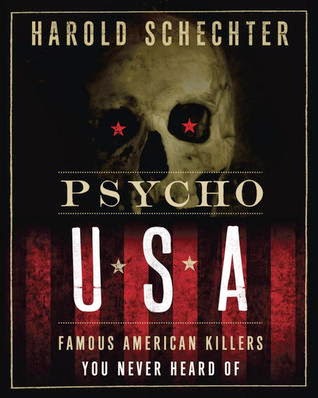
Psycho USA by Harold Schechter is a non-fiction true crime ebook that I received through NetGalley.  In this book, Schechter has compiled short but gruesome accounts of several of the most shocking murderers in United States history.  These men and women were, in their respective times, considered to be the perpetrators of Crimes of the Century - the most vile and atrocious fiends this country had ever seen.  But they have since faded into obscurity.

Now, however, Schechter has brought them back.  Psycho USA is separated into seven sections, each representing different eras, and each chapter within those sections is devoted to one killer.  Section I, for example, covers the period from 1782-1826, and the last section covers from 1941-1961.  Within many of the chapters are also some side-note boxes, covering points of interest that are mentioned in the main text, such as murder ballads or a discussion on the history and/or psychology behind a particular style of murder.  I found these very interesting, and although I call them "side notes," they're really more like mini-chapters in some cases, since they're more than just little blurbs.  They're just not always specifically about the person who was discussed in that chapter.

Schechter also includes a fair few photos and a lot of quotes from the killers' confessions.  Some of these people just look so "normal," that it really makes me think more about how you really can never tell with anyone how flipping crazy they might be just from looking at them.  Reading the words of some of them, however, it kind of slaps you in the face with how obviously unbalanced they were, and you have to wonder how in the world the people who knew them didn't realize this before the person finally got found out and convicted.

Monday, September 2, 2013

Rescuing the Children: The Story of the Kindertransport

Rescuing the Children:  The Story of the Kindertransport by Deborah Hodge is a non-fiction book about the Kindertransport movement; this was an heroic effort made to evacuate as many Jewish children as possible out of Nazi-controlled Europe just before World War II really started.  This is a part of (pre)-Holocaust history that, sadly, not many people are aware of.  In 1938, nine months before war was declared, things were getting more and more dangerous for European Jews.  Hitler had what seems like almost everyone convinced that the Jews were to blame for their hard times, and these people reacted with hatred and violence.   Many tried to escape as refugees to other countries, fearing the worst for themselves and their families if they stayed any longer in their native countries - but many were refused entry.  The Great Depression gave governments an excuse to bar these people from seeking a safe haven, by being concerned that what precious few jobs they had available would go to these new immigrants rather than to their own citizens.

Kristallnacht, the Night of Broken Glass, was the real catalyst, though, for the birth of the Kindertransport movement.  Mobs of Hitler's followers destroyed Jewish-owned properties, including homes and places of worship.  Jews were killed, and many were arrested and sent to concentration camps.  Jewish parents were faced with what was probably the hardest decision they would ever have to make in their lives:  sending their children thousands of miles away to be taken in by strangers, not knowing when or if they would ever see them again.

Saturday, January 14, 2012

We All Wore Stars

I won my copy of We All Wore Stars by Theo Coster through the LibraryThing Early Reviewers program, and I was well beyond pleased when I received it from the publisher, Palgrave-MacMillan.  For a long time I've had a kind of morbid fascination with the Holocaust.  I love to read anything I can about this tragic event in history, and any time I see that a World War II documentary is on TV, I watch it if I can.  Discovering that I have relatives who were killed in the war was no surprise to me, since my dad's mother's family is Polish; discovering that one of those relatives (maybe I should say one that I know of so far) was not only an inmate in Auschwitz, but was killed there, makes me that much more interested to soak up anything I can get my hands on to learn more about it.

We All Wore Stars is a short book of, as the subtitle reads, "Memories of Anne Frank from Her Classmates."  But it isn't just memories about her - I would describe this book more as a brief collection of memories of the contributors' own wartime experiences.  Coster decided to create a film about his and some of his classmates' experiences from the war, to ensure that their stories would endure after they have passed on; this book seems to be almost a companion to the documentary, in a way, and having read this, I'm very interested in finding the film.  Not many of their classmates survived the war - indeed, a vast majority of Holland's Jewish population in general did not survive - but Coster was able to get in touch with a few individuals, who he met with both as a group and individually, to reminisce about their time together at the Jewish Lyceum in Amsterdam, and to talk about some of their individual experiences after either going into hiding or being arrested and sent to the camps.

Saturday, November 12, 2011

Jane Austen for Dummies

Jane Austen for Dummies by Dr. Joan Klingel Ray is, of course, a part of the ever-growing line of " --- for Dummies" books.  Dr. Ray is a former president of the Jane Austen Society of North America and teaches courses on Austen at university.  This book is full of information about everything Austen - her life, her writing, and her family.  It also provides a great deal of information about life in general during the Regency period, which (as you likely know) is the time during which Jane Austen lived.  Dr. Ray also includes something of a Jane Austen tour guide in one chapter, listing Austen-related places to visit in England (as well as directions on how to get to each place and a URL to the location's website, if one exists).  There are also Top Ten lists and some ideas for discussion for a Jane Austen reading group.  The set-up of the contents is designed so that a straight read-through is not necessary.  You can skip around if you want, to read just the information you're looking for, and anything within each section that might require more information for a better understanding is marked by giving (in parentheses) the chapter where that information can be located.

Don't let the title throw you -  if you are making the choice to read Jane Austen or to read more about her life, then obviously you have excellent taste and are no dummy!

Tuesday, October 25, 2011

Halloween: Pagan Festival to Trick or Treat


Halloween: Pagan Festival to Trick or Treat is a non-fiction book by Mark Oxbrow, about the history of Halloween. He starts back in the Iron Age with the Celts, then progresses up to the modern day, discussing the holiday's beginnings as a celebration of the new season/new year, the holiday as a celebration of loved ones who have passed on, as the Catholic saints' day, and as our modern notion of a night where people get dressed up and children collect candy.

I finished this book last night, and I have to say, I was kind of glad to be done with it. Not that it was a terrible book, because it wasn't. Not exactly. It was extremely informative, but it wasn't quite what I was expecting. Oxbrow really does take us WAY back, and one goal of his in writing this book was to help dispel some of the myths surrounding the origin of Halloween. I think he presents enough information to convince someone that they've been misinformed of the beginnings of this holiday, but the bulk of the text is mainly quotes and excerpts from the sources he used; there is comparatively little of the author's own narrative. I would have liked to read more about what he had to say, rather than reading his sources and then his opinion on the passage quoted.