Tuesday, October 1, 2013

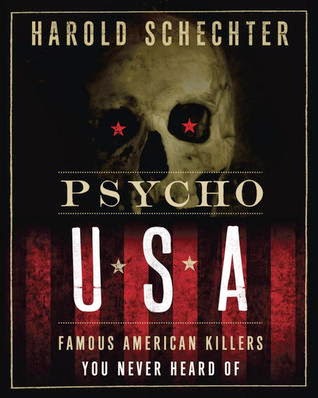
Pyscho USA: Famous American Killers You Never Heard Of

Psycho USA by Harold Schechter is a non-fiction true crime ebook that I received through NetGalley.  In this book, Schechter has compiled short but gruesome accounts of several of the most shocking murderers in United States history.  These men and women were, in their respective times, considered to be the perpetrators of Crimes of the Century - the most vile and atrocious fiends this country had ever seen.  But they have since faded into obscurity.

Now, however, Schechter has brought them back.  Psycho USA is separated into seven sections, each representing different eras, and each chapter within those sections is devoted to one killer.  Section I, for example, covers the period from 1782-1826, and the last section covers from 1941-1961.  Within many of the chapters are also some side-note boxes, covering points of interest that are mentioned in the main text, such as murder ballads or a discussion on the history and/or psychology behind a particular style of murder.  I found these very interesting, and although I call them "side notes," they're really more like mini-chapters in some cases, since they're more than just little blurbs.  They're just not always specifically about the person who was discussed in that chapter.

Schechter also includes a fair few photos and a lot of quotes from the killers' confessions.  Some of these people just look so "normal," that it really makes me think more about how you really can never tell with anyone how flipping crazy they might be just from looking at them.  Reading the words of some of them, however, it kind of slaps you in the face with how obviously unbalanced they were, and you have to wonder how in the world the people who knew them didn't realize this before the person finally got found out and convicted.

Friday, September 6, 2013

The Secret of the Old Clock

The Secret of the Old Clock is the first book in the iconic Nancy Drew Mystery Stories, written by various authors under the pseudonym Carolyn Keene.  Nancy Drew has been a favorite of girls for decades, and her popularity has remained strong to this day, as is evidenced by the many revivals of book series, film adaptations, and even video games.  I even just found out that there is an annual Nancy Drew convention!  You can bet your ass that is a convention I would cosplay at, like...24/7.

Anyway.  So the point here is that I'm sure Nancy Drew needs no introduction, and maybe it's as "pointless" to review books from this franchise as it is to review such modern-day classics as Harry Potter.  But here it is.

Nancy Drew is an 18-year-old  (or 16-year-old, depending on how old your edition is) girl in the midwestern USA and the only child of star lawyer, Carson Drew.  They live in the small-ish town of River Heights, with their housekeeper, Hannah Gruen.  Nancy's mother passed away when Nancy was still very young, and Hannah became like a mother to her.  I haven't read any of these books (except for The Secret of the Old Clock, of course) for years, but I seem to remember Hannah not doing much besides cook.  But that is beside the point.  Nancy is pretty and bright, with a strong sense of personal responsibility and an unswerving sense of right and wrong.  She is quick-thinking and a little sassy, but always friendly and willing to lend a hand wherever one might be needed.  Nancy might get herself into situations at times where you, the reader, are thinking to yourself "what in the hell were you thinking, Nancy Drew, don't you know any better???"  But she never panics - she talks herself calmly and rationally through any predicament, and finds a way out.  A stark contrast to many other female characters of her time, Nancy Drew does not need a man to save her.  HELL no.  She puts on her fabulous outfits and gets in her fancy convertible and she gets shit done.  I mean, in the first chapter of Secret of the Old Clock alone, Nancy SAVES A CHILD'S LIFE.

And the action and suspense just picks up momentum from there.  I mean, yeah, this book was written originally in 1930, then revamped in 1959, so it is a little tame and predictable, and Nancy has some very Mary Sue-like qualities about her, in that she is basically Perfection Incarnate.  She is caring and thoughtful and makes fast friends with everyone (except thieves and rude people, of course, in which case WATCH OUT because she will drive down the highway or across town to report you to the police or the state troopers, even if it means she might be a little late for dinner).  She is beautiful and always very fashionably dressed.  She always knows just what to do in any situation, and always comes out on top.  And even though she is so awesome and everyone always acknowledges how freaking awesome she is, she is always very modest about it.

Regardless, Nancy Drew is an excellent role model for young girls, because even though she does exhibit all these ideally feminine qualities, she has a brilliant and rational mind and is not afraid to speak her mind when necessary.  She has a lot of good sense, and is an overall genuinely nice person.
Monday, September 2, 2013

Rescuing the Children: The Story of the Kindertransport

Rescuing the Children:  The Story of the Kindertransport by Deborah Hodge is a non-fiction book about the Kindertransport movement; this was an heroic effort made to evacuate as many Jewish children as possible out of Nazi-controlled Europe just before World War II really started.  This is a part of (pre)-Holocaust history that, sadly, not many people are aware of.  In 1938, nine months before war was declared, things were getting more and more dangerous for European Jews.  Hitler had what seems like almost everyone convinced that the Jews were to blame for their hard times, and these people reacted with hatred and violence.   Many tried to escape as refugees to other countries, fearing the worst for themselves and their families if they stayed any longer in their native countries - but many were refused entry.  The Great Depression gave governments an excuse to bar these people from seeking a safe haven, by being concerned that what precious few jobs they had available would go to these new immigrants rather than to their own citizens.

Kristallnacht, the Night of Broken Glass, was the real catalyst, though, for the birth of the Kindertransport movement.  Mobs of Hitler's followers destroyed Jewish-owned properties, including homes and places of worship.  Jews were killed, and many were arrested and sent to concentration camps.  Jewish parents were faced with what was probably the hardest decision they would ever have to make in their lives:  sending their children thousands of miles away to be taken in by strangers, not knowing when or if they would ever see them again.

Monday, August 19, 2013

Standing in the Light

Standing in the Light:  The Captive Diary of Catharine Carey Logan is a fictional diary by Mary Pope Osborne, written for the Dear America series.  Caty Logan is a 13-year-old girl living with her family in the Delaware Valley in Pennsylvania.  The Logans are Quakers - a pacifist religious group that began in England and spread to North America in the late 1600s, when some of them emigrated to escape religious persecution.  Quakers have been historically very politically active in the fight for universal civil rights and gender equality, although they also tend to practice modesty and humility in general behavior and appearance (at least during the time in which this book is set).

It is 1763, just after the French and Indian War, and Caty is worried because there have been reports of raids on farmers around the valley, in retaliation of the English government going back on their treaties with the local villages regarding land ownership.  Caty's father believes that their family will be safe if they show the Indians that they trust them, and has faith in the friendly relations the Quakers have had with the Delaware Indians in the past.  Despite this, however, Caty and her brother Thomas are taken captive on their way to school one winter morning; after hearing the rumors at school of people being scalped, Caty fears the worst.

After a while, Caty loses track of the days, though curiosity and what seems like admiration causes her captors to allow her to continue writing in her diary, and from the day she and Thomas are taken, the book becomes a letter to their father, in case it should ever find its way back to him.

Once the small party reaches a village, Thomas is taken away:  will she ever see him or the rest of their family again?

Thursday, August 8, 2013

The Confident Woman

The Confident Woman:  How to Boost Self-Esteem and Happiness for Everyday Women by Carolina Ordoñez is exactly what it sounds like:  a self-help book for women.  Ordoñez has taken her journey from being a meek and depressed young girl to a confident and successful woman, sharing anecdotes of her own experience while explaining what she did to improve herself.  Each chapter focuses on one particular aspect, and Ordoñez discusses why the issue is important to your self-esteem, what she did to change this aspect in her own life, and offers advice as to what she personally recommends to truly get the most out of improving yourself with regards to this aspect.  At the end of the book are lists of recommended reading and videos to watch, which are relevant to the bettering of oneself. 

-------------

The Confident Woman may be a quick read, but this is certainly not a book that guarantees a quick fix for your self-esteem issues.  To be completely honest, when I started it, I actually wondered a little whether such a short book could really even be all that helpful.  And now that I've finished reading?  My verdict is that The Confident Woman is absolutely a helpful book.  I tend to be fairly picky about the self-help books that I pick up, since most of them end up falling well short of their purpose for me.  Once in a while, though, I come a cross one, or one is brought to my attention, that shows a bit of promise, and this was one.

Ordoñez writes in a tone that is rather conversational, and I got the sense that I was being given advice by a friend or a trusted acquaintance.  I've read other books of this nature that try to achieve this same tone only to end up coming across as patronizing or condescending, but I got none of that sense from this book.  English is not Ordoñez's first language, and there were some instances where I picked up on that either from the grammar or the language used, and in general, the technical aspects of the book were kind of rough around the edges, so I'd probably send it to an editor for some tidying up, if it were me.  I don't feel that the content of the book suffered much because of this, though, and I think I got a lot out of reading it.

Tuesday, August 6, 2013

A Time to Kill

John Grisham's first novel, A Time to Kill, is a courtroom drama set in 1980s Clanton, Mississippi.  A 10-year-old girl is raped and left for dead by two men, who are subsequently arrested for the crime.  The father, Vietnam veteran Carl Lee Hailey, acquires an M-16 and kills them both as they exit the courthouse after their hearing.  This seems pretty cut and dry:  except it becomes a huge controversy in the small town, because Carl Lee and his daughter are black, and the two men are white.  These days, most people I think would either think "so?" or else would not admit to having a prejudice, but this is a small Southern town with a mostly white population, and being that it is the 1980s, the Civil Rights Movement really wasn't all that long ago.  So there is a strong racial overtone to the issue, and this sets the stage for the rest of the book, especially when Carl Lee's trial makes national news, and the KKK gets involved.

----------------

I'll be honest with you guys.  Courtroom drama and legal thrillers are not really my thing.  Sure, I am studying criminal justice as a minor, but my concentration is in forensics:  I'm more interested in the investigation and laboratory analysis side of things, not so much the hanging-around-in-a-courthouse-and-meeting-with-lawyers side of things.  So if this book had not been assigned for the criminal justice class I've been taking this summer, I would probably not have ever bothered to pick this up.  It was my first time reading Grisham, and may well be the last.  I know he is a best-selling author, but this just was not for me.  I haven't seen the movie adaptation, so maybe adding a live-action element makes the story more compelling, but as far as the book goes, I was actually pretty bored through about 99% of it.

Tuesday, July 30, 2013

Craving

Craving by Kristina Meister, the first in her Apocalyptic series, is a sort of urban fantasy detective novel with a heavy philosophical bent.  Lilith Pierce flies from her home in California to make her estranged sister Eva's final arrangements after getting the call that Eva has committed suicide.  When she goes back to the station the next day to collect Eva's body, however, it turns out the last few days were a vision --- they never actually happened.  Eva once told Lilith that "everything means something," and with that in mind, she is convinced that there is more to her sister's death than meets the eye.  With the help of her sister's shelves of handwritten journals and a soon-to-be-retired police detective, Lilith begins to investigate Eva's life, and with every step, she finds herself becoming more and more directly involved in the mysterious underworld Eva left behind.

------------------

Sorry for the crazy delay in getting this review up, everyone!  School and things have been keeping me occupied and blogging got a little shunted to the side for a while, but I am back!  This might be running a little more slowly for a while, but I hated being on my unexpected hiatus, and I hope to not be inactive for such a long time again.

Anyway, so I finished Craving quite a while ago, but sitting here and thinking about it to write this has brought the story and the character pretty easily to the front of my mind again.  The philosophy/spiritualism is a little on the heavy side for some, I think, so it would certainly not be everyone's cup of tea; it wasn't preachy exactly, but if you're looking for more of a "mindless" read to just kick back and get through, I don't think I'd recommend this one.

That being said, I rather enjoyed Craving, in part because it ended up being very different from what I'd expected.  Based on the sisters' names and on the title, I thought this would be a Judeo-Christian morals in disguise kind of thing - Eva and Lilith?  Yeah.  Not very subtle, or so I thought.  But most of the philosophy in the book centers around Buddhism, which is something I honestly don't know too much about, so if anything is inaccurate, I wouldn't know.  It all sounded very well-researched to me, so either way, it made for some fairly rich storytelling.  The vampire element was interesting and because of the nature of the rest of the plot, Meister has given the reader an "unconventional" take on that niche that might be at least a little more palatable to vampire "purists" than the sparkling variety presented by Meyers in the Twilight saga.