Saturday, February 22, 2014

Harry Potter and the Goblet of Fire

Harry Potter and the Goblet of Fire, by J.K. Rowling, takes us into Harry's fourth year at Hogwarts School of Witchcraft and Wizardry.  And I think you know by now that Harry and his friends will never have a normal school year.  The book starts us off at the end of the summer, when Harry is invited to go with Ron's family to see the Quidditch World Cup, the biggest sporting event of the wizarding world.  I mean, he plays on one of the school teams, so he can't NOT go.  The game is very exciting, but nothing compared to the events occurring during the night after the game is over:  although rather than a joyful excitement, it is the kind of excitement which involves a lot of screaming in terror and running for your life.  It seems some of Lord Voldemort's old supporters have decided to use this mass gathering of witches and wizards as an opportunity to have their own kind of fun, which is the opposite of fun for everyone who is not a total asshole.

By the time the kids are all back at school, shit has already been on a slippery slope to getting Real, but no one seems too concerned about it yet because everyone is all kinds of busy with the resurrection of the Triwizard Tournament, an international competition between students of various schools of magic that unfortunately resulted in the deaths of many of its competitors.  And although the ministry has claimed to do its best to keep the mortal danger to a minimum for this one, it seems someone is hoping against that, because someone has put Harry's name into the Goblet of Fire, the magical item responsible for selecting the champion who will be representing each school in the tournament.  I don't know why the idea of someone actively wanting Harry dead should come as any kind of a surprise for him or his friends or anyone who knows him, really, since he has been the victim of conspiracy and attempted murder in all his previous years at this school, too.  But anyway, having your name come out of this goblet is a magical and binding contract, so Harry has no choice but to compete, and the professors and government officials have no choice but to allow it.  

Thursday, January 30, 2014

A Cast of Stones

A Cast of Stones by Patrick W. Carr is both his first novel and the first book in The Staff & The Sword trilogy.  It is an epic fantasy set in a world where the church is second only to the king, though seemingly not by much.  Errol Stone, the village drunkard, is paid handsomely by a church messenger to deliver a package to Pater Martin, a priest who lives outside the village, on the other side of some challenging terrain.  Errol knows the way like the back of his hand, but surefooted as he is, he runs into trouble when he realizes he is being followed by a man in black who apparently wants him dead.  He makes it to the cabin, but only just barely.  This would only be the first in a long string of instances where he likely wishes he had never volunteered to deliver that package, because he ends up becoming a reluctant member of a small party setting out for the city of Erinon - the seat of both the kingdom and the church - and his life is never truly his again.

Thursday, January 16, 2014

Witch Hunters: Professional Prickers, Unwitchers & Witch Finders of the Renaissance

Witch Hunters, by P.G. Maxwell-Stuart, is a non-fiction account of a handful of people who were involved in the investigation of witchcraft during the Renaissance - specifically, people who identified witches as a profession by various means.  There are six chapters in this book, each one dedicated to one particular "witch hunter" or style of determining whether someone is a witch or has been touched by witchcraft:  Martín Del Rio, a Jesuit who researched and wrote extensively on the subject of magic and witchcraft; Pierre de Lancre, a lawyer who became famous for his involvement in the investigation of an "outbreak" of witchcraft in southwest France which resulted in the deaths of hundreds of suspected witches; Battista Codronchi, an Italian medical doctor who held that demonic spirits/witchcraft was at the root of many illnesses; Patrick Morton, an alleged victim of demonic possession after an encounter with suspected witches; John Kincaid, a witch-pricker; and Elizabeth Jameson, who titles the final chapter, which deals with the apparently common practice of accusing one's neighbors.

Tuesday, January 14, 2014

Catch-up


Well, Internet, it is another new year (and has been for a couple of weeks now).  I've been busy, busy, busy with work and school, and I just got back from a month-long holiday.  Work and classes have started back up, so the busy isn't quite over yet, but that doesn't mean the blog is dead!  Reviews will still be coming, they will just continue to be more few and far between for a little while, unless I end up with more free time than expected this semester.

I have so many books that I look very forward to sharing with you all, and I hope you find some of them interesting enough to check out for yourself!  

The reading challenges are a lot of fun, but I might lay off of them until my classes are over, unless a small one pops up that I can't resist.  

So this is 2014 - off to a good start, and I plan to keep it that way.

Photobucket

Saturday, December 14, 2013

Mr. Tiger Goes Wild


Mr. Tiger Goes Wild, written and illustrated by Peter Brown, is a charming children's book about a tiger who has grown tired of the very proper and conservative society in which he lives.  He looks very dapper in that top hat and bow tie, but Mr. Tiger just wants to be free.  When he finally starts acting on this desire, however, his friends and neighbors aren't so happy about it, and he has to leave the city.

Just from this, it sounds like kind of a sad story about intolerance, but Mr. Tiger Goes Wild has a nice ending.  The wild turns out not to be as great as Mr. Tiger expected, and he returns to the city, presumably resigned to resume his previous conformity to the society's rules about behavior and fancy dress.  To his surprise, though, all his friends and neighbors have apparently decided maybe Mr. Tiger had the right idea (to an extent) --- everyone seems to have found a nice balance between being proper and being wild, and they welcome Mr. Tiger back with open arms (open forelimbs?).

Tuesday, October 1, 2013

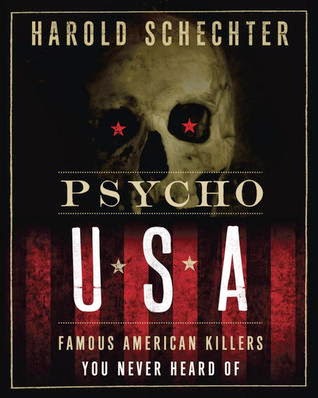
Pyscho USA: Famous American Killers You Never Heard Of

Psycho USA by Harold Schechter is a non-fiction true crime ebook that I received through NetGalley.  In this book, Schechter has compiled short but gruesome accounts of several of the most shocking murderers in United States history.  These men and women were, in their respective times, considered to be the perpetrators of Crimes of the Century - the most vile and atrocious fiends this country had ever seen.  But they have since faded into obscurity.

Now, however, Schechter has brought them back.  Psycho USA is separated into seven sections, each representing different eras, and each chapter within those sections is devoted to one killer.  Section I, for example, covers the period from 1782-1826, and the last section covers from 1941-1961.  Within many of the chapters are also some side-note boxes, covering points of interest that are mentioned in the main text, such as murder ballads or a discussion on the history and/or psychology behind a particular style of murder.  I found these very interesting, and although I call them "side notes," they're really more like mini-chapters in some cases, since they're more than just little blurbs.  They're just not always specifically about the person who was discussed in that chapter.

Schechter also includes a fair few photos and a lot of quotes from the killers' confessions.  Some of these people just look so "normal," that it really makes me think more about how you really can never tell with anyone how flipping crazy they might be just from looking at them.  Reading the words of some of them, however, it kind of slaps you in the face with how obviously unbalanced they were, and you have to wonder how in the world the people who knew them didn't realize this before the person finally got found out and convicted.

Friday, September 6, 2013

The Secret of the Old Clock

The Secret of the Old Clock is the first book in the iconic Nancy Drew Mystery Stories, written by various authors under the pseudonym Carolyn Keene.  Nancy Drew has been a favorite of girls for decades, and her popularity has remained strong to this day, as is evidenced by the many revivals of book series, film adaptations, and even video games.  I even just found out that there is an annual Nancy Drew convention!  You can bet your ass that is a convention I would cosplay at, like...24/7.

Anyway.  So the point here is that I'm sure Nancy Drew needs no introduction, and maybe it's as "pointless" to review books from this franchise as it is to review such modern-day classics as Harry Potter.  But here it is.

Nancy Drew is an 18-year-old  (or 16-year-old, depending on how old your edition is) girl in the midwestern USA and the only child of star lawyer, Carson Drew.  They live in the small-ish town of River Heights, with their housekeeper, Hannah Gruen.  Nancy's mother passed away when Nancy was still very young, and Hannah became like a mother to her.  I haven't read any of these books (except for The Secret of the Old Clock, of course) for years, but I seem to remember Hannah not doing much besides cook.  But that is beside the point.  Nancy is pretty and bright, with a strong sense of personal responsibility and an unswerving sense of right and wrong.  She is quick-thinking and a little sassy, but always friendly and willing to lend a hand wherever one might be needed.  Nancy might get herself into situations at times where you, the reader, are thinking to yourself "what in the hell were you thinking, Nancy Drew, don't you know any better???"  But she never panics - she talks herself calmly and rationally through any predicament, and finds a way out.  A stark contrast to many other female characters of her time, Nancy Drew does not need a man to save her.  HELL no.  She puts on her fabulous outfits and gets in her fancy convertible and she gets shit done.  I mean, in the first chapter of Secret of the Old Clock alone, Nancy SAVES A CHILD'S LIFE.

And the action and suspense just picks up momentum from there.  I mean, yeah, this book was written originally in 1930, then revamped in 1959, so it is a little tame and predictable, and Nancy has some very Mary Sue-like qualities about her, in that she is basically Perfection Incarnate.  She is caring and thoughtful and makes fast friends with everyone (except thieves and rude people, of course, in which case WATCH OUT because she will drive down the highway or across town to report you to the police or the state troopers, even if it means she might be a little late for dinner).  She is beautiful and always very fashionably dressed.  She always knows just what to do in any situation, and always comes out on top.  And even though she is so awesome and everyone always acknowledges how freaking awesome she is, she is always very modest about it.

Regardless, Nancy Drew is an excellent role model for young girls, because even though she does exhibit all these ideally feminine qualities, she has a brilliant and rational mind and is not afraid to speak her mind when necessary.  She has a lot of good sense, and is an overall genuinely nice person.