Sunday, April 9, 2017

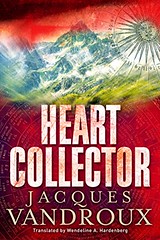
Heart Collector

Heart Collector, originally published as Au Cœur du Solstice, is a crime thriller by French author Jacques Vandroux (translated by Wendeline Hardenberg).  I wish the translation hadn't completely altered the title, because the original title makes much more sense.  That is neither here nor there, though, and any other slight awkwardness in the writing that could be a product of translation didn't detract from the story, to me.

In Heart Collector, we follow police captain Nadia Barka as she investigates a series of abductions (and subsequent murders) of young women in Grenoble, a city nestled at the foot of the French Alps.  Assisting in the investigation is Julien, a computer technician who, for some reason, is having visions of the victims just hours prior to their deaths.  Despite knowing how crazy it will make him seem, Julien brings his information to the police, where he is obviously met with skepticism.

Capt. Barka feels she has nothing to lose from following Julien's tips, however, as there are few enough viable leads for this case, and some of the details of the murders bring to mind a case from her past that still haunts her - the murder of another young woman who had been seemingly tortured extensively before being killed.  Not to mention the fact that these particular murders are especially gruesome - the victims' hearts are nowhere to be found, having been expertly removed.  It becomes a race against time when Julien has a vision of yet another woman:  will he and the police reach her before her heart is removed as well?

----------------------

I got this book through Amazon's Kindle First program, and I'm really glad I selected it as my free ebook for that month.  When I read the premise, I wasn't sure what to expect, since this seems to be marketed more as mystery/suspense/crime fiction rather than as, like...urban fantasy or something, so it was anyone's guess whether the 6th sense element would end up being too corny, or if it would even work within the context of this story at all.

Sunday, March 19, 2017

Anna Dressed in Blood

Anna Dressed in Blood is the first book in Kendare Blake's Anna series (although there are only two books so far, so it may remain a duology, I'm not sure).  

Theseus Cassio (Cas for short) is not a typical teenage boy, by any definition of the word "typical."  He has taken over the family business - dispatching murderous ghosts from off this earthly plane.  This work has the family move frequently from place to place, all over the world, wherever the latest legitimate tip sends them; this time, they've followed a tip to Thunder Bay, Ontario, where Cas intends to find and "kill" the ghost known as Anna Dressed in Blood, a teenage girl who was found murdered in the 1950s, and whose ghost has been busy literally ripping apart  anyone unfortunate enough to set foot in her house since.

For Cas, this case feels different from the start, and his instinct proves true when Anna turns out to be unlike any ghost he's yet encountered.  Will he be able to finish the job he came here to do?

--------------------

I got this book back when it was new and making its initial rounds in the book blog community, but I only just got around to reading it; the premise and the cover art really drew me in.  I enjoy paranormal fiction and ghosts, so this seemed right up my alley.  For the most part, it didn't totally disappoint.

Thursday, March 9, 2017

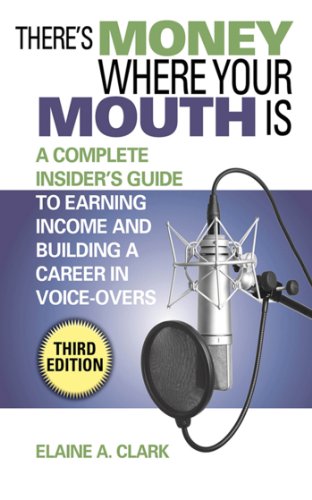
There's Money Where Your Mouth Is

There's Money Where Your Mouth Is by Elaine A. Clark is as subtitled:  A Complete Insider's Guide to Earning Income and Building a Career in Voice-Overs.  In only 23 chapters, Clark covers everything a beginner to voice-over could possibly want or need to know, from simply what voice-over is, to recording tips and producing a quality demo reel, to working with an agent and the differences between union and non-union work.  I have the 3rd edition of this book.

If you've ever read anything about working professionally in voice-over, then a lot of the information in Clark's book will be a review for you, but that isn't a bad thing - fundamentals are always important to remember, no matter the topic, and the way Clark breaks down each aspect of the field makes it simple to learn even if you're just skimming through instead of properly reading it.

Where this book truly shines is that it is so comprehensive as to include a variety of detailed copy samples for the reader to practice the concepts and tips Clark discusses.  In books like this, I always prefer to be given that sort of content; I'm not much of a creative type, in that I would never know what to come up with if I had to write my own copy to practice with.  It would just feel silly and disingenuous, which pretty much defeats the purpose.  Besides, I'm not a professional in the field - Clark has already made a successful career in voice-over, so I can trust that copy samples she provides are representative of what one would see when booking a job. 

Sunday, March 5, 2017

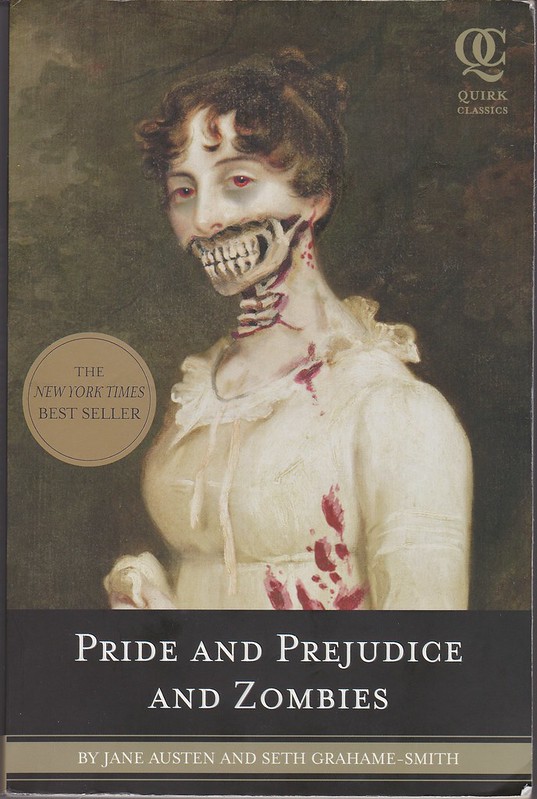
Pride and Prejudice and Zombies

I am back from the longest hiatus ever, and the first book I'd like to share about is Pride and Prejudice and Zombies, by Seth Grahame-Smith (and, of course, our friend Jane Austen).  I'm pleased for this to be the first book I review coming back, as it's one I truly enjoyed.  

A mysterious plague has befallen the nation, so rather than the Napoleonic Wars, the country is battling against the rising dead; the sisters Bennet are trained (and well proficient) in the deadly arts, and although they studied in China rather than the more fashionable Japan, their prowess is nigh incomparable, and they are tasked with the defense of their home at Longbourn and the surrounding neighborhood - until such time as they each marry, as upon taking a nuptial vow, their duty will shift from crown to husband.

I don't think this book needs much more introduction or explanation of the premise than that, since it has been made into a movie, so let's just get right to it, shall we?  As with Sense and Sensibility and Sea Monsters, when I originally bought this book, I wasn't sure whether I'd be going into it with mixed feelings or what, but after having read that, I went into this with much more enthusiasm from the start.  Even though the two novels have different authors, they have a very similar feel, and both Grahame-Smith and Winters have done an equally commendable job of weaving the new elements in with the original stories in a way that makes these books hold their own:  you don't need to have read the original works to understand or appreciate these as stand-alone novels (although I highly recommend that you do read Austen's, because she was a treasure and her collective work is a gift).  

Thursday, June 18, 2015

Moxyland

Moxyland by Lauren Beukes is a cyberpunk novel set in a dystopian, not-too-distant future Cape Town, South Africa.  Big corporations run everything, and society is essentially controlled through technology:  for example, law enforcement can easily use a citizen's cell phone to tase them, and being disconnected is one of the worst things that can happen to a person.  Corporate-run orphanages are used to train and recruit employees, and the penalty for attempting to defect to a rival company can be high.

Beukes's book follows the intertwined stories of four young people:  Kendra, an art school drop-out who's been accepted to participate in a potentially sketchy marketing program; Toby, a drug-addicted vlogger who engages in all kinds of illicit activity in Cape Town's underground scene; Tendeka, an activist trying to foster revolution against the corporate tech-driven society; and Lerato, product of a corporate orphanage and now a high-ranking employee for Communique.

When I read Neuromancer, I thought that cyberpunk was just way too technical for me.  I didn't major in computer science, I'm not a programmer, and you're going to completely lose me with all that sort of jargon.  But then I read Snow Crash, and I felt like I "got it." Moxyland is written more along that sort of vein:  there's an element of grit and seediness amidst all the shiny future tech, and that is the sort of cyberpunk that I can get on board with.  

Thursday, May 28, 2015

The One That Got Away

The One That Got Away by Simon Wood is a contemporary mystery/crime thriller, and a good one at that.  Zoë and Holli are grad students at UC Davis who went to Las Vegas to let their hair down and de-stress, but on the drive back, something terrible happens.  Zoë wakes up to find herself naked and bound in a dirty toolshed, and she can hear someone screaming - it's Holli.  They had stopped for food and gas in a small town, but everything is fuzzy and Zoë can't remember what got them into this situation.  All she can think about is getting out of it.

Fifteen months later, the events of that night have changed Zoë completely.  Her life is on a much different track and she's a different person now.  She hasn't gotten over what happened - not even close - but she's coping in her own way.  That is, until something happens that sends her right back into the path of the man who abducted her and Holli.  The media has nicknamed him the "Tally Man," and it seems he has a score to settle with Zoë.

Thursday, May 21, 2015

Her Dear & Loving Husband

Her Dear & Loving Husband, by Meredith Allard, is the first in her Loving Husband trilogy.  After a recent divorce, Sarah Alexander has moved to Salem, Massachusetts.  If she thought the quaint seaside town with all its historic charm would quiet her recurring dreams and night terrors, however, she was very much mistaken - moving to Salem seems to have had the opposite effect, in fact.  

Through a colleague at the library, Sarah meets James Wentworth, a professor at the college, and her resemblance to his late wife causes him to feel drawn to her.  James is hiding a secret which keeps him disconnected from engaging in any kind of a real social life and has kept him from being settled in any one place for very long.  His attachment to Sarah is powerful enough to potentially disrupt the quiet life he's built for himself, but there are questions which need to be answered:  is James attracted to Sarah, or is it her resemblance to his beloved wife which attracts him to her?  And if it IS Sarah he is attracted to, will his secret threaten any romance between them?

With a meddling reporter buzzing around asking questions about James, his secret might come out whether he's ready for Sarah to know it or not - but if exposed to the whole world, James fears a new mass hysteria and hunt will ensue.

Monday, May 11, 2015

Audition

Audition, by Michael Shurtleff, is a book written for actors to provide information and tips about auditioning.  Working as a casting director for several years, Shurtleff observed many different actors making many of the same mistakes, and this book is meant to help the actor to go into auditions better prepared.

References and language that Shurtleff used in this book are now out-dated (it was published in 1978), but the information he provides is timeless.  Most of the chapters go over general information of interest to actors regarding auditioning in general, and although it seems to be mainly focused on acting for the stage, I imagine only minor adaptations would need to be made when preparing for a film or voice-over role, as the fundamentals of the craft are essentially the same.

The real meat of Audition is the second chapter, in which Shurtleff has outlined his 12 Guideposts.  In fact, for the acting class I took, the guideposts were the reason this book was assigned.  These are 12 aspects to any character and scene which are recommended for an actor to consider, as thinking about and answering the relevant questions will have you as prepared as it is perhaps possible to be for any audition - not to mention that having already explored the guideposts for the audition will mean you aren't beginning from scratch with your character if you end up being cast.  Shurtleff's guideposts are:

Wednesday, February 11, 2015

The Devil's Arithmetic

The Devil's Arithmetic, by Jane Yolen, is an historical fiction novel about the Holocaust, geared toward younger readers.  Thirteen-year-old Hannah is on her way to celebrate Passover with her family, but she'd much rather stay with her friend Rosemary, eating Easter candy.  She feels like every year, the Seder is the same - they do the Seder ritual with dinner and the adults talk about the past, and how important it is to remember.  Hannah doesn't want to talk about things that happened so long ago, and she gets bored of her family's stories.  

When her Grandpa Will declares that she will be the one to open the front door for the prophet Elijah this year, Hannah feels silly, but she goes along with the tradition.  Upon opening the door, however, she doesn't see the apartment building's hallway and the doors to the neighbors' apartments - instead, she finds herself transported to another time and place.  She has, in fact, been transported to Poland of the 1940s, where she will come to experience for herself the horror of the stories she used to dismiss.

Sunday, February 1, 2015

Ticker

In Ticker, by Lisa Mantchev, we follow Penelope Farthing (who rides a motorized velocipede, lol), her twin brother, and their friends on a romp of suspense and intrigue as they try to track down the Farthings' kidnapped parents and the now-madman who was once the family's trusted friend and physician.  

Penny was born with the same defect of the heart which claimed the lives of both her sisters; after a traumatic accident, Warwick surgically removed Penny's biological heart and implanted what was only meant to be a prototype of its eventual clockwork replacement.  However, when the truth comes out about how Warwick developed and tested the clockwork "Ticker" on people he abducted off the street, the family is shocked, and Penny becomes unkindly known as the first of the "augmented" - an abomination in the eyes of some.  But Warwick's trial is underway; maybe once he has been convicted, the family can begin to move on and try to find some peace.

The day of the verdict goes anything but smooth, however - there's an explosion at the Farthing family's factory, where Penny was on her way to meet her brother.  On top of this, their parents have been abducted, and the ransom demands not money, but the family's Augmentation research.  With what seems a little twist at every turn, will Penny and her friends be able to find her parents before any harm comes to them?  Will she even be able to solve this before her worn-out prototype Ticker finally gives out?

Monday, January 12, 2015

Blood Drive

Blood Drive by Jeanne C. Stein is the second book in the Anna Strong Chronicles, and picks up two months after Anna's becoming a vampire.  She's still picking up the pieces of her life after that night and especially after the way things went down with Avery, she's determined to maintain as much as possible some semblance of her human life - something that is becoming increasingly more difficult all the time, in ways she hadn't predicted.

In Blood Drive, however, things get even more complicated when the last girlfriend of her late brother shows up after more than ten years, claiming to need her help.  Anna didn't like Carolyn when she was dating her brother, and she doesn't trust her now, but the help she needs is with her daughter, Trish - Anna's niece.  Anna isn't as easily persuaded as her parents that her brother is the girl's father, but she agrees to help find her.  When a friend of Trish's turns up dead, however, and Anna begins uncovering evidence of the things Trish has been involved in, her protective instincts start kicking into overdrive and leaves open some very difficult questions:  Who can she trust?  Will she be able to reign in her rage enough to contain her newly acquired thirst for blood,  or will she lose her grip on what's left of her humanity?

Thursday, January 8, 2015

Chinese Medicine for Healthy Skin


Chinese Medicine for Healthy Skin by Michelle O'Shaughnessy, as the subtitle states, is a "Chinese Medicine Guide to Vibrant Skin, Ageless Beauty and Vitality."  Traditional Chinese medicine includes such practices as acupuncture, herbal remedies, and tai chi, and has been in use for centuries upon centuries.  In the world of what is considered Western culture, these practices are being used more and more, although I believe most people use them as complementary treatments to a more modern medical approach.

O'Shaugnessy is a Doctor of Oriental Medicine and owns a clinic in Orlando, Florida.  She also runs a website which sells herbal medicinal soups.

-----

I received this as an ebook for review (quite a long time ago, I am sorry to say - I have a shameful backlog after being on the longest hiatus I ever hope to take from blogging), and I am glad that I was finally able to get around to reading it.  Prior to reading this, I didn't really know anything about traditional Chinese medicine apart from some VERY basic concepts.  I am, however, interested in holistic/herbal remedies for things.  Not being able to afford health insurance tends to make you more interested in finding ways to maintain your health and do what you can without racking up bills with a doctor.

So the title of this book specifies that the content will offer a guide to obtaining healthier skin through use of Chinese medicine, and that's exactly what O'Shaugnessy provides.  What surprised me, though, is that the nature of traditional Chinese medicine is such that the remedies actually target many other parts of the body as well; this is all because of the flow of energies that connects everything together, and in treating one area, you are also treating the directly related areas.  Chinese Medicine for Healthy Skin gives an excellent sort of crash course to all of this in the beginning chapters, discussing the history of Chinese medicine, as well as the concepts of qi (chee), yin and yang, and meridians.

Basically, Chinese medicine is about getting the energies of your body into harmony and keeping them that way - not treating one thing by substituting pain or discomfort for (potentially equally annoying) side effects.  

Saturday, February 22, 2014

Harry Potter and the Goblet of Fire

Harry Potter and the Goblet of Fire, by J.K. Rowling, takes us into Harry's fourth year at Hogwarts School of Witchcraft and Wizardry.  And I think you know by now that Harry and his friends will never have a normal school year.  The book starts us off at the end of the summer, when Harry is invited to go with Ron's family to see the Quidditch World Cup, the biggest sporting event of the wizarding world.  I mean, he plays on one of the school teams, so he can't NOT go.  The game is very exciting, but nothing compared to the events occurring during the night after the game is over:  although rather than a joyful excitement, it is the kind of excitement which involves a lot of screaming in terror and running for your life.  It seems some of Lord Voldemort's old supporters have decided to use this mass gathering of witches and wizards as an opportunity to have their own kind of fun, which is the opposite of fun for everyone who is not a total asshole.

By the time the kids are all back at school, shit has already been on a slippery slope to getting Real, but no one seems too concerned about it yet because everyone is all kinds of busy with the resurrection of the Triwizard Tournament, an international competition between students of various schools of magic that unfortunately resulted in the deaths of many of its competitors.  And although the ministry has claimed to do its best to keep the mortal danger to a minimum for this one, it seems someone is hoping against that, because someone has put Harry's name into the Goblet of Fire, the magical item responsible for selecting the champion who will be representing each school in the tournament.  I don't know why the idea of someone actively wanting Harry dead should come as any kind of a surprise for him or his friends or anyone who knows him, really, since he has been the victim of conspiracy and attempted murder in all his previous years at this school, too.  But anyway, having your name come out of this goblet is a magical and binding contract, so Harry has no choice but to compete, and the professors and government officials have no choice but to allow it.  

Thursday, January 30, 2014

A Cast of Stones

A Cast of Stones by Patrick W. Carr is both his first novel and the first book in The Staff & The Sword trilogy.  It is an epic fantasy set in a world where the church is second only to the king, though seemingly not by much.  Errol Stone, the village drunkard, is paid handsomely by a church messenger to deliver a package to Pater Martin, a priest who lives outside the village, on the other side of some challenging terrain.  Errol knows the way like the back of his hand, but surefooted as he is, he runs into trouble when he realizes he is being followed by a man in black who apparently wants him dead.  He makes it to the cabin, but only just barely.  This would only be the first in a long string of instances where he likely wishes he had never volunteered to deliver that package, because he ends up becoming a reluctant member of a small party setting out for the city of Erinon - the seat of both the kingdom and the church - and his life is never truly his again.

Thursday, January 16, 2014

Witch Hunters: Professional Prickers, Unwitchers & Witch Finders of the Renaissance

Witch Hunters, by P.G. Maxwell-Stuart, is a non-fiction account of a handful of people who were involved in the investigation of witchcraft during the Renaissance - specifically, people who identified witches as a profession by various means.  There are six chapters in this book, each one dedicated to one particular "witch hunter" or style of determining whether someone is a witch or has been touched by witchcraft:  Martín Del Rio, a Jesuit who researched and wrote extensively on the subject of magic and witchcraft; Pierre de Lancre, a lawyer who became famous for his involvement in the investigation of an "outbreak" of witchcraft in southwest France which resulted in the deaths of hundreds of suspected witches; Battista Codronchi, an Italian medical doctor who held that demonic spirits/witchcraft was at the root of many illnesses; Patrick Morton, an alleged victim of demonic possession after an encounter with suspected witches; John Kincaid, a witch-pricker; and Elizabeth Jameson, who titles the final chapter, which deals with the apparently common practice of accusing one's neighbors.

Tuesday, January 14, 2014

Catch-up


Well, Internet, it is another new year (and has been for a couple of weeks now).  I've been busy, busy, busy with work and school, and I just got back from a month-long holiday.  Work and classes have started back up, so the busy isn't quite over yet, but that doesn't mean the blog is dead!  Reviews will still be coming, they will just continue to be more few and far between for a little while, unless I end up with more free time than expected this semester.

I have so many books that I look very forward to sharing with you all, and I hope you find some of them interesting enough to check out for yourself!  

The reading challenges are a lot of fun, but I might lay off of them until my classes are over, unless a small one pops up that I can't resist.  

So this is 2014 - off to a good start, and I plan to keep it that way.

Photobucket

Saturday, December 14, 2013

Mr. Tiger Goes Wild


Mr. Tiger Goes Wild, written and illustrated by Peter Brown, is a charming children's book about a tiger who has grown tired of the very proper and conservative society in which he lives.  He looks very dapper in that top hat and bow tie, but Mr. Tiger just wants to be free.  When he finally starts acting on this desire, however, his friends and neighbors aren't so happy about it, and he has to leave the city.

Just from this, it sounds like kind of a sad story about intolerance, but Mr. Tiger Goes Wild has a nice ending.  The wild turns out not to be as great as Mr. Tiger expected, and he returns to the city, presumably resigned to resume his previous conformity to the society's rules about behavior and fancy dress.  To his surprise, though, all his friends and neighbors have apparently decided maybe Mr. Tiger had the right idea (to an extent) --- everyone seems to have found a nice balance between being proper and being wild, and they welcome Mr. Tiger back with open arms (open forelimbs?).

Tuesday, October 1, 2013

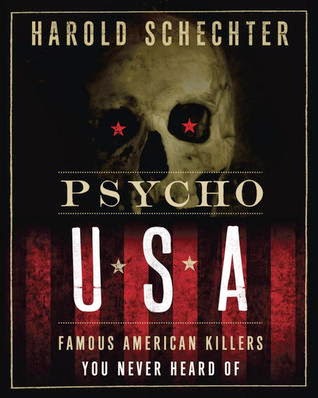
Pyscho USA: Famous American Killers You Never Heard Of

Psycho USA by Harold Schechter is a non-fiction true crime ebook that I received through NetGalley.  In this book, Schechter has compiled short but gruesome accounts of several of the most shocking murderers in United States history.  These men and women were, in their respective times, considered to be the perpetrators of Crimes of the Century - the most vile and atrocious fiends this country had ever seen.  But they have since faded into obscurity.

Now, however, Schechter has brought them back.  Psycho USA is separated into seven sections, each representing different eras, and each chapter within those sections is devoted to one killer.  Section I, for example, covers the period from 1782-1826, and the last section covers from 1941-1961.  Within many of the chapters are also some side-note boxes, covering points of interest that are mentioned in the main text, such as murder ballads or a discussion on the history and/or psychology behind a particular style of murder.  I found these very interesting, and although I call them "side notes," they're really more like mini-chapters in some cases, since they're more than just little blurbs.  They're just not always specifically about the person who was discussed in that chapter.

Schechter also includes a fair few photos and a lot of quotes from the killers' confessions.  Some of these people just look so "normal," that it really makes me think more about how you really can never tell with anyone how flipping crazy they might be just from looking at them.  Reading the words of some of them, however, it kind of slaps you in the face with how obviously unbalanced they were, and you have to wonder how in the world the people who knew them didn't realize this before the person finally got found out and convicted.

Friday, September 6, 2013

The Secret of the Old Clock

The Secret of the Old Clock is the first book in the iconic Nancy Drew Mystery Stories, written by various authors under the pseudonym Carolyn Keene.  Nancy Drew has been a favorite of girls for decades, and her popularity has remained strong to this day, as is evidenced by the many revivals of book series, film adaptations, and even video games.  I even just found out that there is an annual Nancy Drew convention!  You can bet your ass that is a convention I would cosplay at, like...24/7.

Anyway.  So the point here is that I'm sure Nancy Drew needs no introduction, and maybe it's as "pointless" to review books from this franchise as it is to review such modern-day classics as Harry Potter.  But here it is.

Nancy Drew is an 18-year-old  (or 16-year-old, depending on how old your edition is) girl in the midwestern USA and the only child of star lawyer, Carson Drew.  They live in the small-ish town of River Heights, with their housekeeper, Hannah Gruen.  Nancy's mother passed away when Nancy was still very young, and Hannah became like a mother to her.  I haven't read any of these books (except for The Secret of the Old Clock, of course) for years, but I seem to remember Hannah not doing much besides cook.  But that is beside the point.  Nancy is pretty and bright, with a strong sense of personal responsibility and an unswerving sense of right and wrong.  She is quick-thinking and a little sassy, but always friendly and willing to lend a hand wherever one might be needed.  Nancy might get herself into situations at times where you, the reader, are thinking to yourself "what in the hell were you thinking, Nancy Drew, don't you know any better???"  But she never panics - she talks herself calmly and rationally through any predicament, and finds a way out.  A stark contrast to many other female characters of her time, Nancy Drew does not need a man to save her.  HELL no.  She puts on her fabulous outfits and gets in her fancy convertible and she gets shit done.  I mean, in the first chapter of Secret of the Old Clock alone, Nancy SAVES A CHILD'S LIFE.

And the action and suspense just picks up momentum from there.  I mean, yeah, this book was written originally in 1930, then revamped in 1959, so it is a little tame and predictable, and Nancy has some very Mary Sue-like qualities about her, in that she is basically Perfection Incarnate.  She is caring and thoughtful and makes fast friends with everyone (except thieves and rude people, of course, in which case WATCH OUT because she will drive down the highway or across town to report you to the police or the state troopers, even if it means she might be a little late for dinner).  She is beautiful and always very fashionably dressed.  She always knows just what to do in any situation, and always comes out on top.  And even though she is so awesome and everyone always acknowledges how freaking awesome she is, she is always very modest about it.

Regardless, Nancy Drew is an excellent role model for young girls, because even though she does exhibit all these ideally feminine qualities, she has a brilliant and rational mind and is not afraid to speak her mind when necessary.  She has a lot of good sense, and is an overall genuinely nice person.

Monday, September 2, 2013

Rescuing the Children: The Story of the Kindertransport

Rescuing the Children:  The Story of the Kindertransport by Deborah Hodge is a non-fiction book about the Kindertransport movement; this was an heroic effort made to evacuate as many Jewish children as possible out of Nazi-controlled Europe just before World War II really started.  This is a part of (pre)-Holocaust history that, sadly, not many people are aware of.  In 1938, nine months before war was declared, things were getting more and more dangerous for European Jews.  Hitler had what seems like almost everyone convinced that the Jews were to blame for their hard times, and these people reacted with hatred and violence.   Many tried to escape as refugees to other countries, fearing the worst for themselves and their families if they stayed any longer in their native countries - but many were refused entry.  The Great Depression gave governments an excuse to bar these people from seeking a safe haven, by being concerned that what precious few jobs they had available would go to these new immigrants rather than to their own citizens.

Kristallnacht, the Night of Broken Glass, was the real catalyst, though, for the birth of the Kindertransport movement.  Mobs of Hitler's followers destroyed Jewish-owned properties, including homes and places of worship.  Jews were killed, and many were arrested and sent to concentration camps.  Jewish parents were faced with what was probably the hardest decision they would ever have to make in their lives:  sending their children thousands of miles away to be taken in by strangers, not knowing when or if they would ever see them again.