Showing posts with label adapted for film. Show all posts

Sunday, March 5, 2017

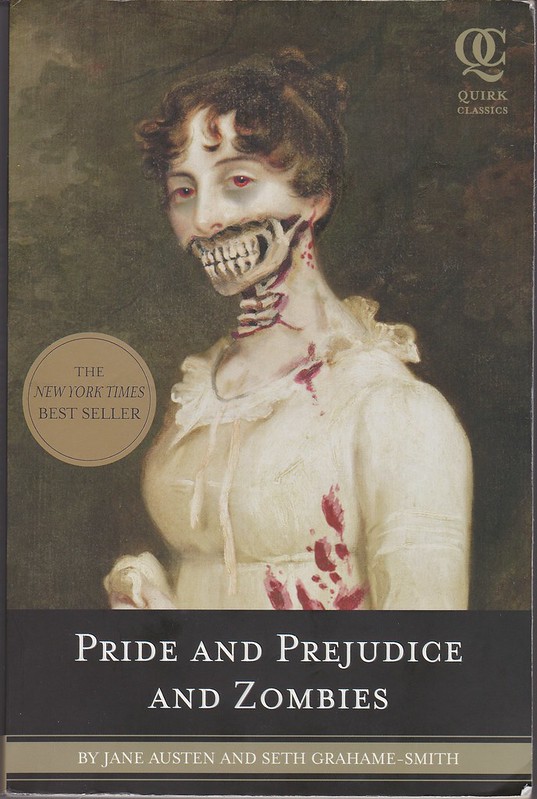
Pride and Prejudice and Zombies

I am back from the longest hiatus ever, and the first book I'd like to share about is Pride and Prejudice and Zombies, by Seth Grahame-Smith (and, of course, our friend Jane Austen).  I'm pleased for this to be the first book I review coming back, as it's one I truly enjoyed.  

A mysterious plague has befallen the nation, so rather than the Napoleonic Wars, the country is battling against the rising dead; the sisters Bennet are trained (and well proficient) in the deadly arts, and although they studied in China rather than the more fashionable Japan, their prowess is nigh incomparable, and they are tasked with the defense of their home at Longbourn and the surrounding neighborhood - until such time as they each marry, as upon taking a nuptial vow, their duty will shift from crown to husband.

I don't think this book needs much more introduction or explanation of the premise than that, since it has been made into a movie, so let's just get right to it, shall we?  As with Sense and Sensibility and Sea Monsters, when I originally bought this book, I wasn't sure whether I'd be going into it with mixed feelings or what, but after having read that, I went into this with much more enthusiasm from the start.  Even though the two novels have different authors, they have a very similar feel, and both Grahame-Smith and Winters have done an equally commendable job of weaving the new elements in with the original stories in a way that makes these books hold their own:  you don't need to have read the original works to understand or appreciate these as stand-alone novels (although I highly recommend that you do read Austen's, because she was a treasure and her collective work is a gift).  

Wednesday, February 11, 2015

The Devil's Arithmetic

The Devil's Arithmetic, by Jane Yolen, is an historical fiction novel about the Holocaust, geared toward younger readers.  Thirteen-year-old Hannah is on her way to celebrate Passover with her family, but she'd much rather stay with her friend Rosemary, eating Easter candy.  She feels like every year, the Seder is the same - they do the Seder ritual with dinner and the adults talk about the past, and how important it is to remember.  Hannah doesn't want to talk about things that happened so long ago, and she gets bored of her family's stories.  

When her Grandpa Will declares that she will be the one to open the front door for the prophet Elijah this year, Hannah feels silly, but she goes along with the tradition.  Upon opening the door, however, she doesn't see the apartment building's hallway and the doors to the neighbors' apartments - instead, she finds herself transported to another time and place.  She has, in fact, been transported to Poland of the 1940s, where she will come to experience for herself the horror of the stories she used to dismiss.

Saturday, February 22, 2014

Harry Potter and the Goblet of Fire

Harry Potter and the Goblet of Fire, by J.K. Rowling, takes us into Harry's fourth year at Hogwarts School of Witchcraft and Wizardry.  And I think you know by now that Harry and his friends will never have a normal school year.  The book starts us off at the end of the summer, when Harry is invited to go with Ron's family to see the Quidditch World Cup, the biggest sporting event of the wizarding world.  I mean, he plays on one of the school teams, so he can't NOT go.  The game is very exciting, but nothing compared to the events occurring during the night after the game is over:  although rather than a joyful excitement, it is the kind of excitement which involves a lot of screaming in terror and running for your life.  It seems some of Lord Voldemort's old supporters have decided to use this mass gathering of witches and wizards as an opportunity to have their own kind of fun, which is the opposite of fun for everyone who is not a total asshole.

By the time the kids are all back at school, shit has already been on a slippery slope to getting Real, but no one seems too concerned about it yet because everyone is all kinds of busy with the resurrection of the Triwizard Tournament, an international competition between students of various schools of magic that unfortunately resulted in the deaths of many of its competitors.  And although the ministry has claimed to do its best to keep the mortal danger to a minimum for this one, it seems someone is hoping against that, because someone has put Harry's name into the Goblet of Fire, the magical item responsible for selecting the champion who will be representing each school in the tournament.  I don't know why the idea of someone actively wanting Harry dead should come as any kind of a surprise for him or his friends or anyone who knows him, really, since he has been the victim of conspiracy and attempted murder in all his previous years at this school, too.  But anyway, having your name come out of this goblet is a magical and binding contract, so Harry has no choice but to compete, and the professors and government officials have no choice but to allow it.  

Monday, August 19, 2013

Standing in the Light

Standing in the Light:  The Captive Diary of Catharine Carey Logan is a fictional diary by Mary Pope Osborne, written for the Dear America series.  Caty Logan is a 13-year-old girl living with her family in the Delaware Valley in Pennsylvania.  The Logans are Quakers - a pacifist religious group that began in England and spread to North America in the late 1600s, when some of them emigrated to escape religious persecution.  Quakers have been historically very politically active in the fight for universal civil rights and gender equality, although they also tend to practice modesty and humility in general behavior and appearance (at least during the time in which this book is set).

It is 1763, just after the French and Indian War, and Caty is worried because there have been reports of raids on farmers around the valley, in retaliation of the English government going back on their treaties with the local villages regarding land ownership.  Caty's father believes that their family will be safe if they show the Indians that they trust them, and has faith in the friendly relations the Quakers have had with the Delaware Indians in the past.  Despite this, however, Caty and her brother Thomas are taken captive on their way to school one winter morning; after hearing the rumors at school of people being scalped, Caty fears the worst.

After a while, Caty loses track of the days, though curiosity and what seems like admiration causes her captors to allow her to continue writing in her diary, and from the day she and Thomas are taken, the book becomes a letter to their father, in case it should ever find its way back to him.

Once the small party reaches a village, Thomas is taken away:  will she ever see him or the rest of their family again?

Tuesday, August 6, 2013

A Time to Kill

John Grisham's first novel, A Time to Kill, is a courtroom drama set in 1980s Clanton, Mississippi.  A 10-year-old girl is raped and left for dead by two men, who are subsequently arrested for the crime.  The father, Vietnam veteran Carl Lee Hailey, acquires an M-16 and kills them both as they exit the courthouse after their hearing.  This seems pretty cut and dry:  except it becomes a huge controversy in the small town, because Carl Lee and his daughter are black, and the two men are white.  These days, most people I think would either think "so?" or else would not admit to having a prejudice, but this is a small Southern town with a mostly white population, and being that it is the 1980s, the Civil Rights Movement really wasn't all that long ago.  So there is a strong racial overtone to the issue, and this sets the stage for the rest of the book, especially when Carl Lee's trial makes national news, and the KKK gets involved.

----------------

I'll be honest with you guys.  Courtroom drama and legal thrillers are not really my thing.  Sure, I am studying criminal justice as a minor, but my concentration is in forensics:  I'm more interested in the investigation and laboratory analysis side of things, not so much the hanging-around-in-a-courthouse-and-meeting-with-lawyers side of things.  So if this book had not been assigned for the criminal justice class I've been taking this summer, I would probably not have ever bothered to pick this up.  It was my first time reading Grisham, and may well be the last.  I know he is a best-selling author, but this just was not for me.  I haven't seen the movie adaptation, so maybe adding a live-action element makes the story more compelling, but as far as the book goes, I was actually pretty bored through about 99% of it.

Sunday, April 14, 2013

Mockingjay

Mockingjay by Suzanne Collins, as I am sure at least most of you know, is the final installment of the widely popular Hunger Games trilogy.  It picks up a little bit after the final events in Catching Fire, so we've got a little catching up to do with Katniss as to what the heck is going on.  Probably you already had a clue, though, because it's not entirely difficult to figure at least most of that business out.  She's managed to survive the arena again, but the reality of what is going on in the districts and in the Capitol is overwhelming at best.  The pattern continues that every decision she makes, thought-out or not, seems to result in torture or loss of life, but the rebels want her to become the public face and voice of the revolution.  Do the potential benefits of this outweigh the certain consequences it will have on the prisoners of the Capitol?  Or will she just end up doing more damage than actual good?  Will the districts succeed in overthrowing the Capitol, or will things just end up worse for everyone than before?

-----------

I was originally reading something else for my non-school book, but I got kind of bored with that, what with its Wall Street-central plot, so when Mockingjay finally came in the mail, I decided to go ahead and read this one instead (although I did re-read the first two in the trilogy before starting on it...you know you would have done the same).  Anyway, I got through this book very quickly, as I did the others.  Collins has a true talent for writing a hell of a page-turner, and I think it is to her credit that she manages to write a story that appeals so deeply to so many people, without having any sex in the plot.  I mean, okay, there is some pretty obvious sexual tension, but I'm talking about some sexytimes action scenes.  I'm pretty grateful for that, actually, because I'm sure that would have made Katniss about a million times more confused about her conflicted feelings for Gale and Peeta, and I had enough vicarious anxiety to deal with, without all that nonsense.

As for regular ol' action, though, there is plenty of that to go around, especially toward the end.  This kind of book is difficult to write a review of partly for that reason - I would hate to be less vague and inadvertently include spoilers, but trust me when I say that shit is going down all over the place here.  Having read the book finally, I'm more excited to see how they'll present it all in the film adaptation - it is sure to be pretty visually dynamic.  

I am also NOT looking forward to the film adaptation, though, because I spent the entire last third of the book yelling OHMYGOD and weeping like a small, emotionally disturbed child.  I finished the book late last night (early this morning?) and I am still not entirely sure how I feel about how it all ended.  I appreciate that Collins provided a more realistic end to things, since it is not what I'd call the Happiest Ever After, but it's still satisfying on some level, albeit a smidge unsettling in a way.  See?  Still not 100% how I feel about it all, except to say that it was a hell of a way to wrap things up.  

Mockingjay ended up being my least favorite of the trilogy, but that in no way means I didn't like it.  I still think they're all phenomenal, and a great contribution to the dystopian sub-genre.  Just, you know, if you're a total sap like me, maybe read it with a box of tissues handy or something, and not in the middle of the night if you live with someone who is a light sleeper, since you might wake them up with all the crying-out in shock and disbelief.

ISBN:
9781407109374

ASIN:
B003XF1XOQ

Publisher:
Scholastic Press

Series Info:  What came before this book?  What's next?
The Hunger Games
- The Hunger Games (Book 1)
- Catching Fire (Book 2)
* Mockingjay (Book 3)
See what others are saying about it, or buy it now:
Amazon
Better World Books

Photobucket

Saturday, December 29, 2012

The War of the Worlds

The War of the Worlds, by H.G. Wells, is a classic science fiction tale of Martian invasion.  The story is narrated by a philosopher who lives a quiet life in the English country with his wife.  When visiting an astronomer friend at his observatory one night, they witness what would seem to be shooting stars, but for the fact that they appeared to have been fired directly from Mars.  It is not too long before a large metallic cylinder comes crashing into the earth near their homes.  The news gets out of course, but no one is alarmed at first, since it takes a rather long time for the martians to emerge from their cylinder, and once they are out, they don't appear to be capable of leaving the crater their vessel made.  Their sluggishness and apparent immobility is attributed to their not being able to adjust to the additional gravitational force on this planet, and everyone feels quite safe because of it.

Up until the martians finish constructing their deadly heat ray, that is, and begin burning to death everything within its range.

This unfortunate turn of events is...well...unfortunate.  But they still can't get out of the crater, right?  So as long as you're not in range of this heat ray, you're safe.

Except then it turns out the martians have also brought along things to put together humongous death machines to roam about the countryside in, burning up stuff with their heat rays and snatching up people to feed upon, and causing a widespread general panic.  The military of course was called in, but this is the late 19th century, so their weapons are obviously no match against the superior technology of the martians.  Humankind is pretty screwed, yeah?

Maybe, maybe not.  

Wednesday, September 5, 2012

The Lion, the Witch and the Wardrobe

The Lion, the Witch and the Wardrobe by C.S. Lewis is a classic children's fantasy story set during World War II.  Four siblings (Peter, Susan, Edmund, and Lucy) are sent to the country to escape the bombing of London, and the house where they are to be living is owned by an old and eccentric professor.  There are many rooms to explore, all full of fascinating and mysterious things.  While exploring the house, the children come across a room that is empty except for a large, wooden wardrobe.  Lucy soon discovers that this wardrobe is a kind of doorway into another world:  Narnia.

She meets a faun not long after entering, and after becoming friends with him, she finds that if she doesn't leave quickly, she will become the prisoner of the White Witch, the dictator-queen.  Of course, when she gets back through the wardrobe and tells her siblings about the wood she found through the wardrobe, none of them believe her; it's not until later, when they all find themselves forced to hide in the wardrobe together from the professor's housekeeper, that they see for themselves that she was telling the truth (although Edmund had actually got into Narnia once as well, and met Lucy on his way out, but he's kind of a dick, so he lied to Peter and Susan about it).

The real adventure starts when they all go to visit Lucy's friend, the faun, only to find that he has been arrested for not turning Lucy in to the witch.  They agree (Edmund not really so much) that it's only right to try and help Mr Tumnus if they can, since it was because of Lucy that he was arrested in the first place.  

---------------

I can't even count how many times I've read this book.  The entire series is great, and I never get tired of reading each of the books.  Because of the movie that came out back in 2005, this is probably the most well-known of the series.  I like the Pevensie children (except Edmund not so much at first, since he's kind of a little d-bag); they aren't exactly the most complex characters you will ever come across, but that doesn't make them awful or too boring.  Sometimes I get a little annoyed with how goody-goody they seem, because that just does not feel very real, but they are children living during one of the worst times in modern history, so maybe they're just trying to make the best of things as well as they can.

Saturday, August 25, 2012

Austenland

In Austenland, by Shannon Hale, we meet Jane Hayes:  30-something graphic designer living in New York.  Jane's had thirteen boyfriends in her life, and none of them ever quite match up to her idea of what a man should be.  And what's her ideal man like?  Mr. Darcy.  Yes, Jane has more than just a slight Austen obsession.  She's so obsessed with Jane Austen's novels and with Mr. Darcy in particular, that she goes so far as to hide her copy of the BBC Pride & Prejudice mini-series (ladies, you know the one...Colin Firth).  

During a visit from her mother and wealthy great-aunt Carolyn, the old woman notices the DVDs and knows immediately what is going through Jane's head.  Great-aunt Carolyn surprises Jane by booking a vacation for her at Pembrook Park, a sort of Regency reenactment resort in the English countryside, where guests and a staff of actors remain in period dress and manner for three weeks.  The clientele consists of Austen-obsessed women, who pay the exorbitant fee to be fake-courted by gentlemen like Austen's male characters.  

Jane isn't sure what to make of her great-aunt's strange gift, but the tickets and reservation are nonrefundable, and the prospect of being in the company of handsome men in breeches has piqued her interest.  Once she checks in, however, and the fantasy begins, the total immersion is a little more than she thinks she can really handle.  Will it help her kick her Darcy fixation, or will she just get even more sucked in than before?  

Friday, July 13, 2012

One for the Money

The widely popular Stephanie Plum series by Janet Evanovich begins with One for the Money; Stephanie is a Jersey Girl who has been laid off from her job as a lingerie buyer for what I suppose is a department store.  She's had to hock all her furniture and most of her household appliances just to make rent and attempt to keep her phone active, and her car has just been repossessed.  She hears that her cousin Vinnie, a bail bondsman, is looking for a file clerk, and even though he is completely skeevy (he has apparently done some very...intimate...things to a duck), Stephanie is desperate.

Turns out Vinnie is no longer hiring, but his receptionist lets Stephanie know that they're down a recovery agent, and if she's really in need of the cash, she could take up the guy's cases while he's out.  One of those cases is Joe Morelli, the neighborhood heartbreaker.  He introduced Stephanie to below-the-belt kinds of games when they were young children, and in high school he sealed the deal and never called her again (what a catch, right?).  After that, she ran him down with her dad's car.  Now he's a cop who's been charged with murder and he's skipped bail.  This puts the tempting price of $10,000 on his head, and Stephanie immediately agrees to take  the job.

So when her first attempt to bring Morelli in fails miserably - did she really think she could go in, completely unprepared, and he'd go down to the station with her, just like that?  - Vinnie's receptionist gets Stephanie in touch with Ranger, some hotshot bounty hunter, to show her the ropes.  It's a good thing, too, because she ends up needing his help several, several times.  

Stephanie runs into Morelli many times, and even steals his car since it's nicer than her Nova, but she never actually gets any closer to bringing him in.  She does, apparently, continue to find him irresistible, and who can blame her, what with his charming track record?!?  He does save her from a criminally insane prize boxer, Benito Ramirez, when the guy tries to proposition her and beat her in view of several other men (who neither say nor do anything to stop it), after she tries to question him about a woman associated with Morelli's case.  Things get worse for Stephanie (and pretty much for everyone she talks to, as well) as she starts to close in on something big, and it doesn't help that she is now being stalked and terrorized by Ramirez, who has taken it very badly that she refused his advances.

This is all very overwhelming for someone with zero real training or experience, and whose street smarts extend only as far as removing the distributor cap from a vehicle to prevent auto theft (though I'm not sure that counts, since that trick is apparently common knowledge in her neighborhood).  Will Stephanie Plum be able to put together all the pieces and bring in Morelli to collect on the ultimate payday?  Or will she die trying?

Sunday, July 8, 2012

Catching Fire

I know that at this point, it is probably unnecessary to explain anything about Suzanne Collins' amazing dystopian Hunger Games series.  I reviewed the first book earlier this year, so that I would have read it before seeing the movie.  I knew before I had even finished the first chapter that I was hooked and needed to start trying to get my hands on a copy of the second in the trilogy, Catching Fire.  I had received my copy of The Hunger Games in a giveaway, and I needed to get the UK edition of the sequels, so that they would match on my bookshelf.  Yeah, yeah...picky, I know, but so what?  I like the covers better anyway.  It was sold out on The Book Depository, but I couldn't wait any longer for them to email me about it being restocked, so I ended up finding it on Better World Books.  It came in the mail last week, and I could not wait to read it - I know those of you who have read it already understand.

I stayed up almost all night rereading the first book, and I started reading Catching Fire earlier today.  And I did not stop until just a little while ago, when I had finished.

Even those of you who have not read the books or seen the movie of the first book likely know that Katniss survived the Games, since you know...there are two books after that first one.  It's no secret anyway, since anyone can pick up the sequels and figure that out from the cover blurbs.  Their final act in the Games which secured their co-victory - something without precedent - has been seen as one of open defiance.  The Girl on Fire may have ignited a spirit of rebellion in the districts and become the symbol of a coming revolution.  But the smoking patch of rubble that was once District 13 makes it very clear what lengths the Capitol is willing to go to, to put a stop to things, and the game they must now play against President Snow may prove to be much more dangerous than the Hunger Games itself ever was.

Catching Fire, just like its predecessor, is absolutely amazing.  The entire series so far is thrilling; Collins writes in such a way that it is very easy to become immersed in the world she has created in Panem:  to visualize the surroundings as if you were there yourself, to find yourself crying with and for characters at emotional moments, to find yourself holding your breath for several pages before finally sighing with relief or gasping and/or yelling out of something else entirely, be it anger, disbelief, or surprise.  There is every bit as much suspense and action as in The Hunger Games - arguably more, even, and the stakes are much higher now that the citizens of all the districts are potentially involved, affected by whatever move is made.  This time, it isn't just about killing or out-living 23 other people.  It's about Prim.  Rue's family.  Gale.  Peeta. Her mother.  Everyone.

Sunday, June 17, 2012

The Wonderful Wizard of Oz

L. Frank Baum's The Wonderful Wizard of Oz (sometimes published with the shorter title The Wizard of Oz) is regarded as the first American fairy tale, and it is one of those stories that every American child would be familiar with, even if they haven't read the book themselves.  This is a story of self discovery:  young Dorothy lives on a farm in Kansas with her Aunt Em and Uncle Henry; one day, a cyclone comes and picks up their house, with Dorothy and her dog Toto inside (she didn't make it into the storm cellar with her aunt and uncle).  Fortunately, she isn't hurt - rather, she gets bored or something after a while, goes to her bed, and falls asleep.  She wakes up when the house is set down none too gently in a strange and very colorful land full of strange little people.

The Good Witch of the North informs Dorothy that she is in the land of the Munchkins, and points out that Dorothy's house has landed on the Wicked Witch of the East, killing her.  Dorothy wants to get back to Kansas, and since with the death of the witch comes the munchkins' freedom, they are more than happy to help her.  They set her up with some provisions and the Witch of the North kisses Dorothy, leaving a mark of protection, then points her in the direction of the Land of Oz.  Dorothy decides her practical and worn-in boots are no good for a long journey on foot, and since the Witch of the East is dead and so will not be walking anywhere anytime soon, Dorothy loots the witch's pretty silver and (unbeknownst to her at the time) magic shoes.

As she travels along the yellow brick road, Dorothy makes a few friends who each desire something for themselves, and Dorothy assures each one that there is no reason this wizard of Oz shouldn't be able to give them what they want, even though she only just heard of the guy and knows nothing about this place.  She's very young, though, so I guess she can't really be blamed for making promises of other people.  The party gets into all kinds of trouble along the way, but miraculously, they make it through every danger completely unscathed.  Eventually, they reach the Emerald City and meet with the wizard, who says sure, he'll grant them each their respective wishes, but only if they go and kill the Wicked Witch of the West first.  She's the last wicked witch left, after all, and since Dorothy downed the other one, this one should be no problem, right?

Tuesday, June 12, 2012

The Invasion

The Invasion is the first book in K.A. Applegate's Animorphs series.  Jake and his friends Cassie, Marco, Rachel, and Tobias are cutting through an abandoned construction site on their way home from the mall one evening when they see a bright light in the sky that appears to be getting closer...it doesn't take long for them to realize that the light is actually a spaceship.  The ship lands and the kids get a message of warning from the dying alien who was piloting it; the people of Earth are in danger.  Another alien race is working on enslaving people by controlling their minds and bodies.  Until help comes, Jake and his friends may have to try and fight the invasion.  To help them, the alien gives them all a gift:  the ability to morph into any animal after acquiring its DNA sequence by touching it.  When the kids start realizing just how many people are already under the alien control, it hits them just how in over their heads they might be.

These books were right up there with Baby-Sitters Club and Goosebumps when I was a kid; come Book Fair time, Animorphs were certainly at the top of the Want List.  There is something very appealing about having the power to change into any animal at will, and to do so in order to fight for the human race would be pretty awesome.  Reading it again as an adult, I realize how cheesy the writing is, but I imagine it isn't so easy to write in the voice of a pre-teen or teenager in a way that might be believable enough to keep the target audience invested in the characters - especially when the way kids talk changes so much over the years.  

The characters so far are pretty one-dimensional, but there are a lot of books in the series, so there is plenty of room for development where that is concerned.  There are things these kids deal with, though, that are definitely not fluffy and childish.  Marco and Tobias don't have the easiest home lives, and the rest of them are about to have to grow up a lot more pretty soon here if they plan to survive the coming war until the Andalites arrive to fight the Controllers.

Saturday, June 9, 2012

True Women

True Women by Janice Woods Windle is a semi-biographical novel of the lives of her own ancestors.  Growing up with stories passed down through the generations in her family, Windle went on to do serious genealogical research, leading to this novel.  True Women takes us through the lives of specifically three women in the author's family tree (which is diagrammed at the beginning of the book):  Euphemia Texas Asby King, Georgia Virginia Lawshe Woods, and Bettie Moss King.  Their stories span from the time of the Republic of Texas, through what seems like war after war after war, up until the present day, when the author is learning more about these women from Idella, an old woman with an intuitive gift.

I was born in East Texas, and I currently live in the area schoolchildren learn as the "prairies and lakes" region of Texas.  We moved around a lot during my childhood, though, and I don't self-identify as Texan.  But while I've personally never felt any real connection with the state, I think it's no secret how proud others are to call themselves Texan.  Some (many) of them, obnoxiously so.  I never much understood it.

This book, however, is about generations of people who have every reason to be proud of being Texan.  Euphemia, her sisters, and many hundreds of other women and children fled from Santa Anna's army in what became known as the Runaway Scrape.  They helped to make Texas the Republic it once was, and  managed not only to just survive in the harsh environments they chose to call home, but they worked hard and came to thrive in what I feel is a nearly impossible place to live.  This is the part of the book that really sets it apart from others for me.  Other states have a lot of history from the scars left by the many wars this country has seen, but the time of the Texas Republic is something else.  I've always thought the obnoxious and blind state pride I've seen in Texas was silly, but for those whose roots go as deep as this, I can certainly see what there is to be proud of.  As for myself, I can't say I have any more pride in being born in Texas after having read this book, but I have a much greater respect for the history and the people who struggled through and fought for its beginnings.

Friday, May 18, 2012

The Hobbit


The Hobbit by J.R.R. Tolkien is undoubtedly one of the classics of the fantasy genre; it's the sort of book that adults can enjoy, but that I could very much picture myself reading to my kids before bed (if I had kids).  Yes, of course, there are battles and such (what self-respecting fantasy novel is not going to have any battles?), but I'd say it's relatively tame, and probably wouldn't traumatize your children.

Bilbo Baggins is a hobbit from a well-respected line, with a bit of an adventurous streak through his mother's side (the Took line).  For the most part, hobbits are very simple, quiet folk who mind their own business and keep to themselves and are quite content just sitting around eating and smoking pipes and eating and having some tea and eating and sleeping.  And eating.  Hobbits who go off on adventures of any kind are marked as deviants, because why in the world would any sane person want to go risking their life out in the world where you can't just sit around eating and drinking tea and sleeping most of the day?  

So that's why, when the wizard Gandalf shows up at Bilbo's door to recruit him for a quest, he shuts that conversation down pretty quick, though because he is a hobbit, it doesn't do to be impolite, and he ends up inviting Gandalf to come on back for tea sometime.  Gandalf accepts this invitation, but extends it to thirteen dwarfs (or rather, dwarves, and Tolkien gives an explanation for his use of the -ves plural ending).  You can imagine how surprised and irritated Bilbo was when all these strangers started showing up, and then he finds out it's because he is going to be a part of this adventure whether he likes it or not (which he doesn't).  Especially since this little quest is headed by Thorin Oakenshield, descendant of a dwarf king of old, whose mountain fortress and mounds of treasure have for some time now been in the possession of the dragon Smaug.  Bilbo is expected to come along as the group's burglar, assisting them in the reclaiming of their rightful property by traveling all the way to the Lonely Mountain (which is quite some distance beyond the Misty Mountains, which are not exactly a stone's throw away either) and slaying the dragon.

It had been a long time since I've read The Hobbit, and since I'd apparently forgotten some of the details, it was a thoroughly enjoyable re-read.  At first, I thought "wow, okay, so Gandalf is kind of a dick," what with the devious way he roped Bilbo into going on this little quest with Thorin and his kinsmen.  The dwarfs were none too pleased about it, either, because...a hobbit?  Really, Gandalf?  What the fuck good is a timid little hobbit going to be, especially when all he does is worry about his handkerchiefs and his meals-between-meals and sitting in his armchair by the fire.  But Gandalf gets all kinds of cryptic like he can see into the future or some shit, and insists that they will be pretty glad of Bilbo when all is said and done.  I guess Gandalf is usually a pretty legit kind of guy, since they want to trust his judgment on this, and they set off.

Saturday, April 21, 2012

Harry Potter and the Prisoner of Azkaban


Harry Potter and the Prisoner of Azkaban by J.K. Rowling is the third installment of the widely popular Harry Potter series.  Harry and his friends Ron and Hermione are in their third year at Hogwarts School of Witchcraft and Wizardry, and as per usual, their year does not exactly go smoothly.  Harry is not doing so well to begin with, though; his Uncle Vernon's sister comes to visit toward the end of the summer vacation, and things get a little out of hand.  Harry storms out of the Dursleys' house, set to run away and resigned to being expelled from school and living as a fugitive.  While wondering what to do first, though, he gets picked up by The Knight Bus, which gives rides to stranded witches and wizards, and he goes to London, thinking he may as well start off at The Leaky Cauldron pub.  He's met at the pub by none other but the Minister of Magic himself,  however, and thinks he's in for it.  Rather than be arrested, though, he's set up with a room and told to stick to Diagon Alley, and not to go wandering about in Muggle London.  He doesn't have too much time to ponder the strangeness of the leniency, though, as he's quickly caught up with being back in the wizard world, and soon enough he is joined by his friends, since everyone goes to Diagon Alley to get their back-to-school shopping done.

Just before getting back on the train to Hogwarts, Harry learns some startling news about a mass murderer - Sirius Black - who  has broken out of Azkaban, the wizard prison; the man is considered to be such a danger that even the Muggle law enforcement has been notified to be on the lookout for him and to exercise caution.  Extra security measures have been placed at school, and everyone is worried for Harry's safety especially.  This is probably for the best, since he and his friends seem to have a real knack for getting into life-threatening situations.  Despite all these precautions, however, events continue to unfold which lead Harry, Ron, and Hermione right into Black's path.

Wednesday, April 18, 2012

New Moon

So I've finally gotten around to reading New Moon by Stephenie Meyer.  I'd seen the movie more than a few times, but hadn't really got the chance to read it - once I started, though, it only took me two nights to finish.  The same as Twilight, I know this book doesn't really need an introduction, but here is a refresher anyway.

We are, of course, still in the tiny town of Forks, Washington.  It's been about a year, and Bella and Edward are still together, which is probably a surprise to no one.  It's Bella's birthday, and she's all kinds of moody about it since now she is, for all intents and purposes, now one year older than Edward, and she is not thrilled at the fact that she's aging.  You might recall from the end of the first book that Bella wants Edward to turn her into a vampire so they can truly be together forever, but Edward isn't so keen on the idea, so she's still human (so far).  Anyway, against her wishes, Edward's "sister" Alice has put together a party for Bella at the Cullen house.  Bella, accident-prone as ever, can't get through the thing without a little blood being inadvertently shed, which as you can guess did not go well in a house full of vampires.  Jasper has the hardest time, if you remember, with the whole "vegetarian" lifestyle, and he reacts pretty quickly.  Edward reacts quickly to Jasper reacting quickly, and the party is basically ruined.

There are no hard feelings from Bella since hey, Jasper can't help it, but Edward convinces himself that he really is too much of a danger for her, and the Cullens pack up and leave town in kind of a hurry.  

Bella becomes deeply, deeply depressed and stays this way mostly for the rest of the book, and all of her friends except Jacob Black give up on her.  Bella becomes an adrenaline junkie, and then shit just starts hitting one fan after another.

Monday, April 16, 2012

The Magician's Nephew


The Magician's Nephew by C.S. Lewis is actually not the first book that was published of The Chronicles of Narnia - it was the second to last to be published.  It's usually presented as the first book in the series, however, because it is first chronologically.  Since "Book 1" is printed on the spine of the copy I have, and the omnibus I have has this one first, I can't bring myself to read them in order of publication.

Probably The Magician's Nephew is one of the least known of all seven books, since most people only really know of the books which feature the Pevensie children.  The children in this book are Digory and Polly, a young boy and girl who live next door to each other in London.  Digory's mother is very ill, and his father is in India for work, so he and his mother have come to London to live with her brother and sister in their home.  Digory thinks his Uncle Andrew is straight crazy, and is a little wary of him, and he finds he had good reason to feel this way when one day, he and Polly accidentally get into his upstairs study while exploring a tunnel which runs the length of all the houses.

Uncle Andrew, as it turns out, is a magician.  He is convinced he's unlocked the secret to moving between their world and other worlds, but rather than go himself (he's quite old, you see, this sort of thing is really only fit for someone still young), he tricks Polly into being sent from their world, leaving Digory no choice but to go after her (well, really he does have a choice, but he's not a douche, so he goes).

Monday, March 19, 2012

The Hunger Games

So I went out of town this past week for Spring Break, and decided to bring along a book for the flight and my three hour layover in Chicago.  Since I wouldn't have been able to really do the exercises in Transforming Body Image, I decided to take The Hunger Games by Suzanne Collins.  I won this in a giveaway hosted by Dani at Pen to Paper back in November and really wanted to go ahead and read it before seeing the movie.

The Hunger Games is a sort of dystopian/post-apocalyptic story set in what was once North America, but after the war, is now the nation of Panem - a central capitol surrounded by twelve (previously thirteen) districts.  Each district is responsible for one duty in Panem, and the Capitol is in complete control of the citizens.  Each year, the Capitol hosts The Hunger Games, a televised battle royale reminiscent of the gladiators of ancient Rome, wherein twenty-four tributes - one boy and one girl - from each district is chosen at random to compete to the death in a chosen arena.  Katniss Everdeen wasn't chosen, but volunteered as tribute in place of her younger sister, Prim.  She has some potential advantage due to her experience hunting illegally in the forest outside her district, but the other tributes have their own talents as well, and conditions in the arena are carefully monitored and controlled, to keep the tributes on edge and to maintain some level of entertainment value for those watching from home.  Wits and strength are matched as one by one, tributes are eliminated.  Katniss will need to survive to win and return home to her mother and sister, but to do so will mean killing if necessary.  The winner of the Hunger Games is the last man standing, which means taking the life of her fellow District 12 tribute is a very real possibility.  Peeta is not only a boy she knows, but he and Katniss also have a history of sorts; will Katniss be able to make it through the bloody tradition with minimal blood shed?  Will district loyalty have to be compromised?  Will she even make it out alive?

Friday, January 20, 2012

The Lovely Bones

The Lovely Bones by Alice Sebold is a story centering around a fourteen-year-old girl, Susie Salmon, who is raped and murdered near her home in the 1970s.  She narrates the story after death, as she watches over her family and keeps tabs on her killer from her heaven.  She follows each of her family members as they deal with her death, each in very different ways.  She follows Ruth, a classmate who felt her presence as she passed through a parking lot from this world to the next and whose life is never the same from that moment on.  She follows Ray Singh, another classmate who was in love with her - her almost and only romance.  And she follows the man who took her life.

Rape is difficult for me to read, and it's even more awful to me in this book because of Susie's young age and the gruesome way in which she dies afterward.  Sebold treats this delicate subject matter well, though; perhaps because she herself was a victim of rape.  The scene isn't drawn out, and we get only those details which are vital to the understanding of the story.  So to anyone wary of picking this up because of this topic, I would at least give it a go, because the reading of it isn't as bad as I anticipated.  Of course, you may end up not being able to get through it, but trust me - at least try, because it's really an extraordinary book.